Team led by RRI scientists predicts ‘petal-like’ structures in Sun’s corona during eclipse
Research group of Dibyendu Nandi, senior professor in astronomy and astrophysics at RRI, is among several groups across the globe that pursue the testing of computational models of solar magnetism and space weather through eclipse observations
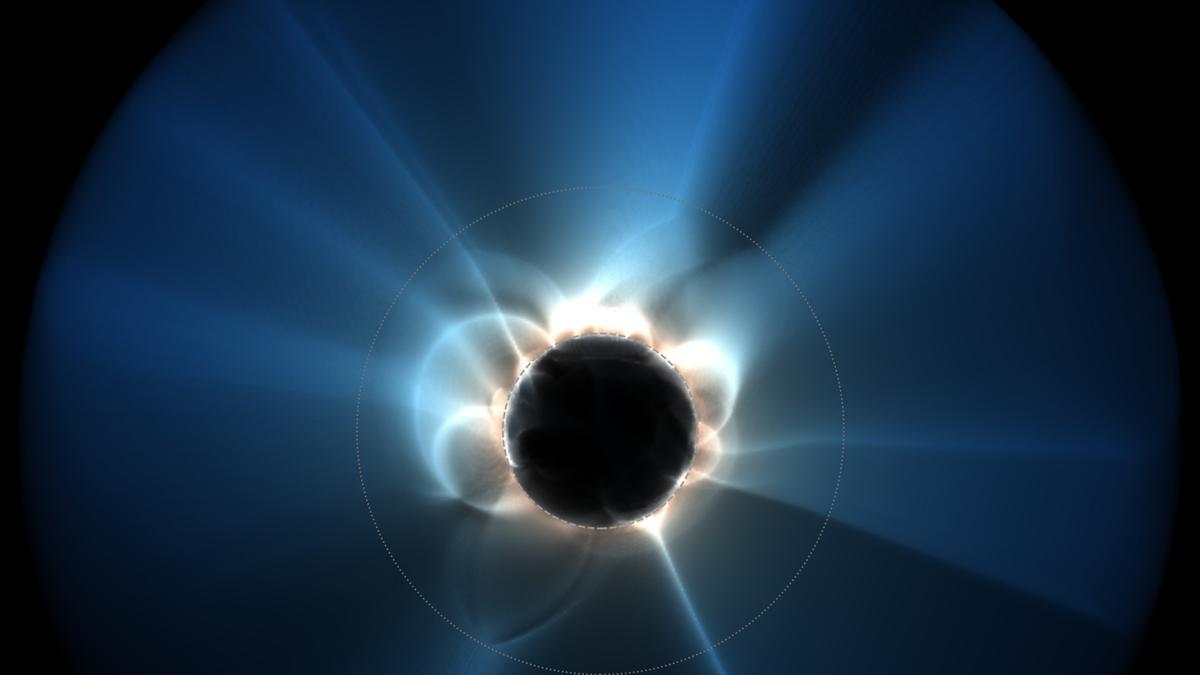
Scientists from the Raman Research Institute (RRI) in Bengaluru, along with international collaborators, have forecasted the magnetic structure of the Sun's corona, or 'crown', during a total solar eclipse on August 12, 2026. The RRI-led team, under the guidance of senior professor Dibyendu Nandi, predicts the presence of multiple large-scale petal-like structures and more localized, elongated petals in the corona during the event.
The corona is typically too faint to detect against the bright solar surface, but a total solar eclipse, when the Moon temporarily blocks the Sun, provides the best opportunity to observe it from the ground. This natural phenomenon allows researchers to test theories and models about the origins of solar storms, flares, and coronal mass ejections, which can have severe impacts on Earth's outer atmosphere and technological infrastructure.
The RRI research group employs a novel computational approach, combining a data-driven model with a separate model rooted in Nandi's theoretical framework, to predict the coronal magnetic field structure. By utilizing observational data up to August 10, 2026, the researchers can simulate the Sun's magnetic field distribution on the day of the eclipse, incorporating the latest available data as of August 10.
The team consists of experts from RRI, the Centre of Excellence in Space Sciences India at IISER Kolkata, the Indian Institute of Astrophysics, the Department of Technical Education and Skill Development in West Bengal, the United States National Solar Observatory, and the University of Reading in the UK.
Written by urgent.news from The Hindu - Sci-Tech's reporting — not their text. Machine-written — may contain errors; check the original before relying on it.