Super election year 2026: This is how the polls stand before the state elections in East Germany
In September, Berlin, Mecklenburg-Vorpommern and Saxony-Anhalt will be voting. The Handelsblatt poll tracker shows: Who will be the strongest force, which party will fail to meet the five percent hurdle?
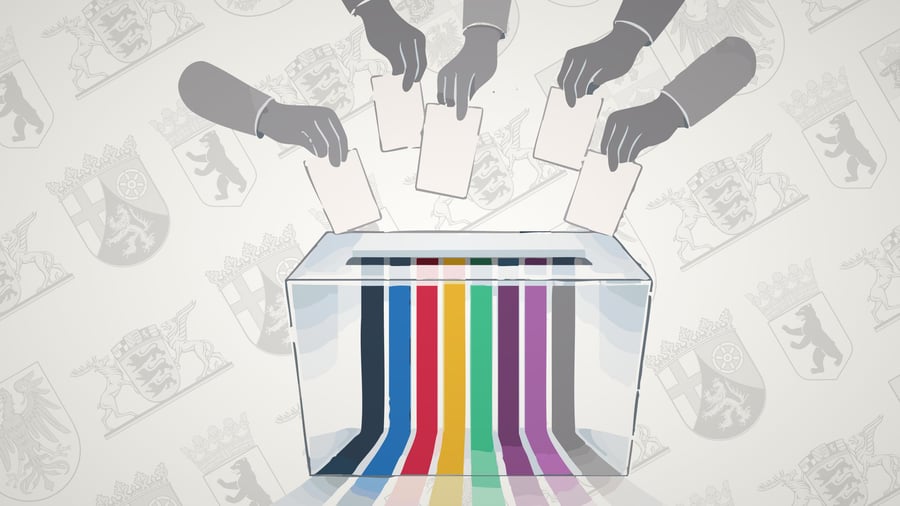
Three state elections are scheduled for September. Elections will be held in the eastern German states of Mecklenburg-Vorpommern, Saxony-Anhalt, and in Berlin. In parts of the far-right AfD is likely to become the strongest force. How do the parties fare and who fails to meet the five percent hurdle? The Handelsblatt's poll tracker keeps you up to date on the 2026 state elections.
The tool shows how the parties are currently polling - and what this means for the distribution of seats in the state parliaments. The graphics are continuously updated and are based on the values of all polling institutes. The Handelsblatt collects the data from the Dawum platform. What do the polls show before the three state elections in September?
In Mecklenburg-Vorpommern and Berlin, the state parliament will be elected on September 20. Two weeks earlier, on September 6, the election will take place in Saxony-Anhalt. There, the AfD is currently leading in the polls with a wide gap ahead of the CDU, followed by the Left Party. SPD, BSW, Greens, and FDP have to worry about entering parliament and could fail to meet the five percent hurdle.
If several of the four parties fail to enter parliament, the AfD could achieve a result of more than 40 percent for an absolute majority. The following graphic shows two scenarios of what the polls could mean for the distribution of seats in the state parliament. The 5 percent scenario shows what the seat distribution would be if the smaller parties did not enter.
Instead of 41 percent of the seats, the AfD would have 53 percent of the parliament - and could govern alone. In Berlin, the Left Party is currently leading with 20 percent, one percentage point ahead of the CDU (19 percent), followed by the AfD (18 percent) and the Greens (17 percent). Who will govern in the Red Town Hall in the future and which coalitions could form is still completely open.
BSW and FDP would fail to meet the five percent hurdle according to the polls. These poll results would lead to the following seat distribution in the House of Representatives. It is quite possible that a government of three parties will have to be formed in Berlin in order to gain a majority. In Mecklenburg-Vorpommern, the AfD is currently leading by a wide margin ahead of the SPD.
CDU and Left Party follow. The BSW is currently at five percent in the poll trend. The Greens would fail to meet the five percent hurdle according to the current status. The following seat distribution would result based on these polls. Elections have already taken place this year in Rhineland-Palatinate and Baden-Württemberg. State elections in Rhineland-Palatinate and Baden-Württemberg In Rhineland-Palatinate, the CDU became the strongest force with 31 percent ahead of the SPD (25.9 percent).
CDU top candidate Gordon Schnieder now leads the coalition together with the Social Democrats. The AfD became the third strongest force (19.5 percent) ahead of the Greens. The Left Party, Free Voters, and FDP failed to enter the state parliament. In the state election in Baden-Württemberg on March 8, the Greens and top candidate Cem Özdemir made up a significant gap: In mid-October, a survey had shown the CDU with a 14 percent lead, on the Thursday before the election, the first survey showed both parties level.
After the election, the Greens and CDU formed a government again, and Özdemir was elected as Minister-President. More: "Slip-ups are not forgotten in the digital world" - top candidates fight for their reputation This article already appeared on February 18, 2026. The article was comprehensively updated on August 11, 2026.
Translated by urgent.news. Machine-written — may contain errors; check the original before relying on it.