Streamflow From Generative AI
The trifecta of predicting, assimilating, and downscaling streamflow has arrived with generative diffusion AI models.
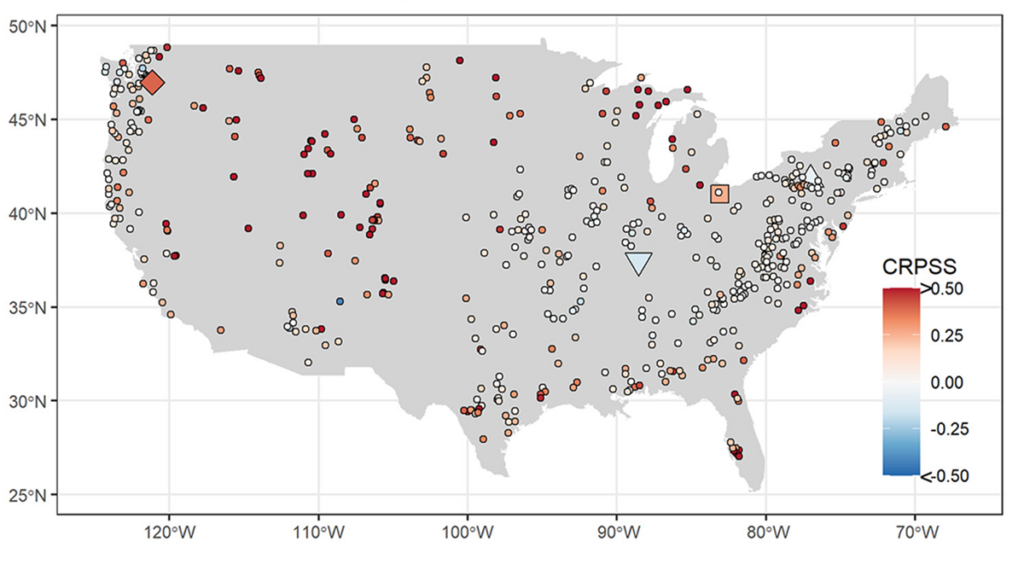
Recent research published in Water Resources Research by Yang et al. [2026] introduces an innovative use of artificial intelligence (AI) for streamflow prediction. The study employs a generative diffusion model, a technology commonly found in smartphone applications, to enhance streamflow forecasting.
Unlike traditional methods, this diffusion model is not only used for predicting streamflow but also for efficiently downscaling and assimilating observations over time. The researchers tested their approach against other methods using the Catchment Attributes and MEteorology for Large-sample Studies (CAMEL) data set, and found that it outperformed competitors, particularly in predicting extreme conditions.
The findings of this study open up new possibilities for addressing key challenges in hydrology. These include dealing with prediction under uncertainty, downscaling data from a larger spatial scale to a smaller one, and integrating models with real-world observations. This advancement in AI-based streamflow prediction could significantly improve hydrological modeling and forecasting, providing more accurate and reliable information for water resource management.
Written by urgent.news from Eos's reporting — not their text. Machine-written — may contain errors; check the original before relying on it.