Should India Worry About the Mecca Pact?
The agreement is not directed against India, but it alters the strategic environment in which India-Pakistan relations play out.
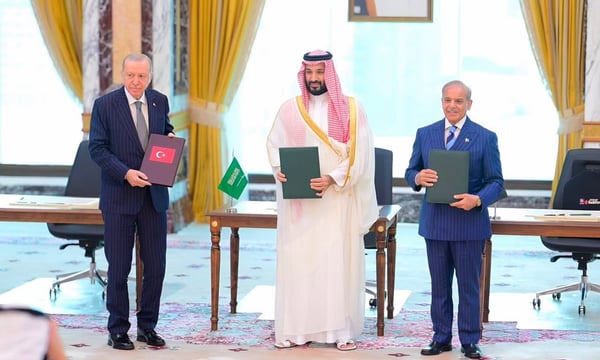
On August 7, the leaders of Saudi Arabia, Türkiye, and Pakistan inked the Mecca Joint Defense Agreement, pledging to treat an attack on one as an attack on all. This bold move is a significant shift in the region's power dynamics, which could reshape the security landscape of the entire region. For India, this new framework warrants attention, as it alters the strategic environment in which India-Pakistan relations unfold.
Pakistan's concept of deterrence, prior to May 2025, was not centered on a protracted war of attrition or achieving conventional military dominance. Instead, it aimed to prevent India from gaining escalation dominance in limited theaters while relying on nuclear deterrence to avoid a larger war. However, the rapid escalation and geographical expansion of the May 2025 conflict demonstrated that nuclear deterrence does not guarantee the absence of sustained conventional fighting below the nuclear threshold.
This experience has left Pakistan with a strategic dilemma: it cannot tolerate repeated military crises that impose prolonged economic burdens. Therefore, Islamabad must enhance its capacity to fight and raise the potential costs of future confrontations sufficiently high that India cannot expect to achieve decisive conventional superiority without incurring broader strategic consequences. The Mecca framework directly supports this objective.
A NATO Article 5-style commitment involving Saudi Arabia and Türkiye could have far-reaching implications, extending diplomatic, economic, and military repercussions beyond the immediate South Asian theater. Pakistan's motivations go beyond deterrence. Historically, Islamabad has faced the risks of excessive dependence on a single supplier of military supplies, with the United States cutting off aid during the 1965 India-Pakistan war.
Today, about 80 percent of Pakistan's weapons systems are Chinese-made. Diversifying defense partnerships can bolster Pakistan's strategic autonomy by reducing vulnerability to external power calculations and supply-chain priorities.
The agreement also emphasizes the growing recognition that military dependence restricts strategic freedom. Saudi Arabia, Türkiye, and Pakistan all have incentives to bolster indigenous defense production instead of remaining reliant on great powers whose interests may diverge from their own. Their complementary capabilities include Saudi Arabia's financial resources for large-scale investment, Türkiye's advanced indigenous defense industry, and Pakistan's operational experience and established defense-industrial base.
Joint research, technology sharing, and co-production could produce capabilities challenging for any one of the three to develop independently.
Moreover, the framework must be viewed within the broader context of Pakistan's evolving relations with West Asia. Over the past decade, India has significantly increased its economic and diplomatic engagement with the Gulf region, expanding its economic weight and forging relationships that extend beyond traditional political ties.
For Pakistan, this has eroded some of the strategic space it once held. To regain relevance, Pakistan must offer capabilities that Gulf states increasingly perceive as vital to their security architecture.
The emerging framework provides Islamabad with an institutional mechanism to translate its defense capabilities into broader diplomatic influence in West Asia. Pakistan's approach to the region is not zero-sum. It has successfully maintained relations with Iran, even as Tehran's connections with several Gulf states have weakened.
This balancing act can serve as leverage, as Iran has a vested interest in keeping channels open with Pakistan. This arrangement could further reduce India's relative influence by fostering credible relations with Iran.
For India, the geographic and political boundaries of a future India-Pakistan confrontation may be less predictable. A conflict that was previously confined to South Asia could attract stronger political and diplomatic reactions from West Asian states. In the event of an active conflict, the Mecca framework could assume greater significance, potentially amplifying India's response.
India seemed caught off guard by the extent of Chinese support to Pakistan during the May conflict, underscoring the evolving nature of regional security dynamics.
Written by urgent.news from The Diplomat's reporting — not their text. Machine-written — may contain errors; check the original before relying on it.