Possible Sangam-age irrigation structure exposed on Kollidam river in Tiruchi district
Villagers stumbled upon the brick and stone structures a few days ago, and ASI team inspects and says it probably belongs to the Early Historic period
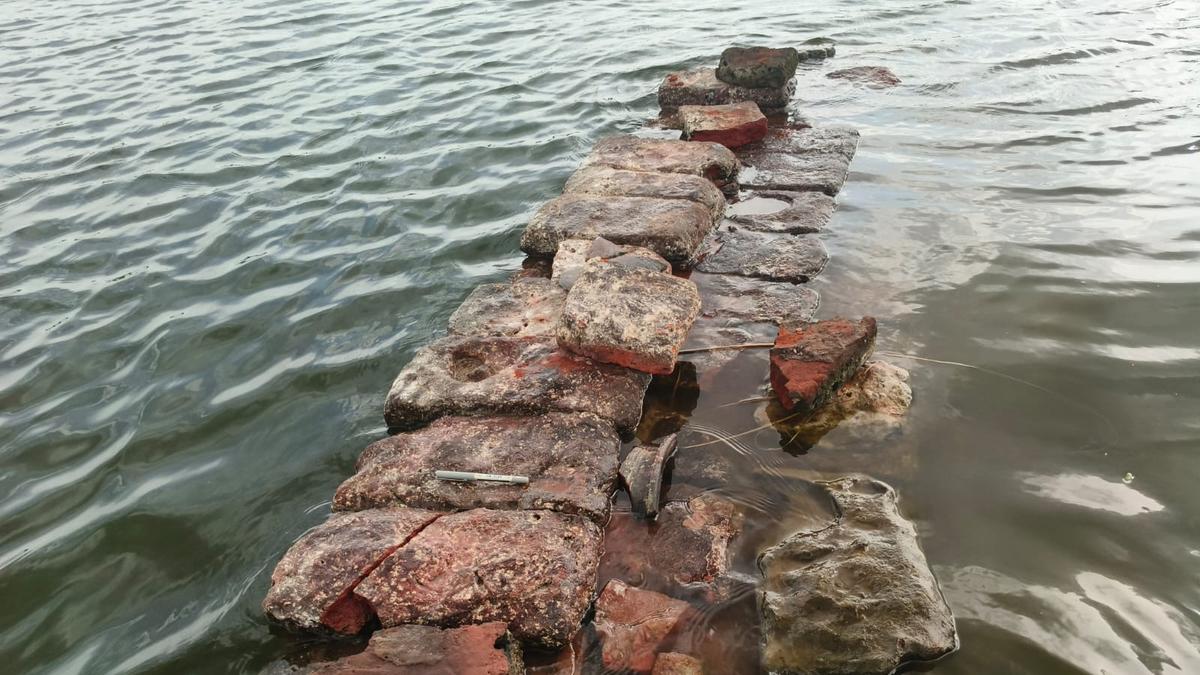
Brick structures were discovered on the Kollidam river bed near Koogur in Tiruchi district, close to the ancient Kallanai dam. The Archaeological Survey of India (ASI) believes these remnants may be from a Sangam-age irrigation structure. Two brick remains were identified, with one semi-circular brick wall and another fully submerged.
The underwater observation revealed two walls parallel to each other, suggesting an entrance or a channel opening. The exposed portion was a linear masonry structure, measuring approximately two feet in height and four feet in width. Archaeologists provisionally identified the structure as an inlet channel from the early historic period (3rd-4th century CE).
The construction, use of large-sized bricks, and location point to the possibility of the structure being a sluice, inlet, or outlet channel. The structures were found by villagers in a pool of water stagnant in the river bed. Photographs of the structures were shared on social media, leading to an inspection by a team of archaeologists from the ASI's Tiruchi Circle.
The brick remains were rectangular and wedge-shaped, with a consistent dimensional ratio, comparable to a water management structure found at Vanagiri near Kaveripattinam. Excavations at Kaveripattinam have revealed a brick-built inlet sluice/channel associated with a reservoir. The large-sized bricks and constructional characteristics suggest an Early Historic/Sangam period structure, but its exact period can only be established after systematic excavation and scientific dating of the materials.
Written by urgent.news from The Hindu's reporting — not their text. Machine-written — may contain errors; check the original before relying on it.