Musification of the 2026 total solar eclipse
Video: 00:05:08 [English] Experience a musical simulation of the 12 August 2026 total solar eclipse as seen from the Observatorio Astrofísico de Javalambre (Spain). int/solareclipse for an overview of all ESA eclipse activities & resources. This is a ‘musification’ – an artistic interpretation of a set of…
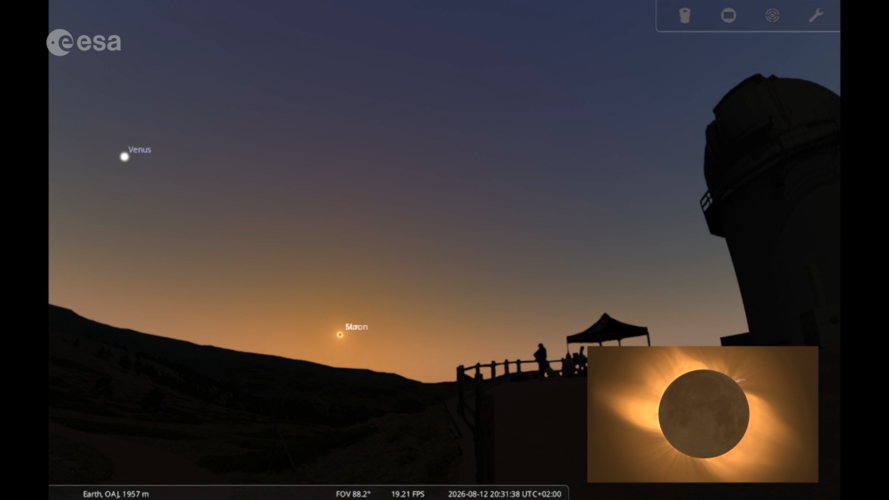
The 12 August 2026 total solar eclipse from the Observatorio Astrofísico de Javalambre in Spain will be accompanied by a unique musical interpretation, a "musification" of data. This collaboration between ESA's CESAR team and Rubén García Benito from the Instituto de Astrofísica de Andalucía (IAA-CSIC) translates the eclipse's characteristics into musical elements.
Nine parameters extracted from a Stellarium simulation guide the composition. The 'arpeggio,' or rapid succession of notes, mirrors the visible sunlight, with its pace, range and volume dictated by the light itself. The accompanying 'pad' or background chord changes color based on the light's warmth, growing darker as it turns redder.
A 'bass' element represents the darkness of the eclipse, reaching maximum intensity during totality. 'Heartbeat' signifies the tension of fading light, settling during the eclipse. 'Bells' mark key moments: the first contact (C1), second contact (C2), maximum eclipse, and third contact (C3).
During totality, a 'shimmering sound' represents the solar corona. As the eclipse concludes, a 'descending whoosh' signifies the Sun disappearing behind the horizon. A low, persistent 'night drone' signals the onset of night when the Sun passes below the horizon. Finally, 'stars' appear as soft sparkling tones, visible at night but not during totality. This artistic representation transforms raw eclipse data into a captivating auditory experience.
Written by urgent.news from ESA Space Science's reporting — not their text. Machine-written — may contain errors; check the original before relying on it.