Jochen Flasbarth: "The Union's arch-nemesis": How a seasoned official drives the CDU to despair
Hardly any official is as powerful as State Secretary for the Environment Jochen Flasbarth. How the controversial climate protection fighter pulls the strings behind the scenes.
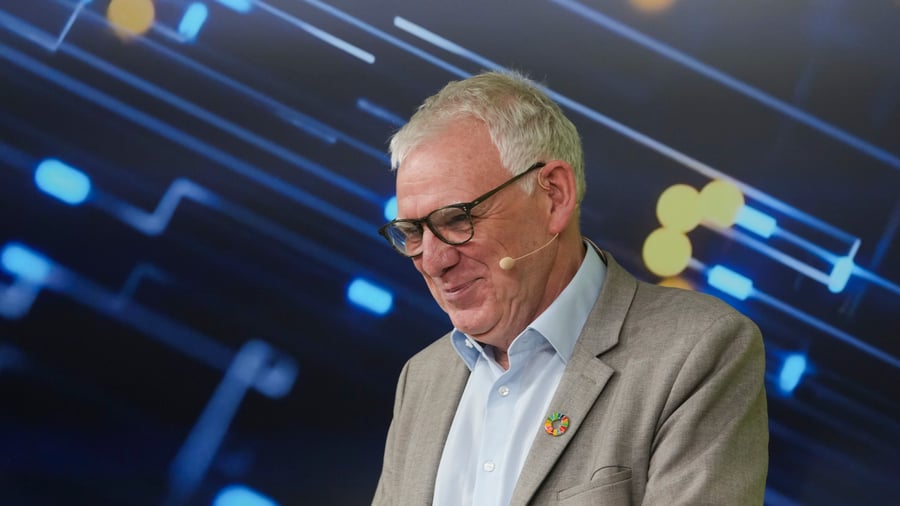
To get his message across, Jochen Flasbarth did not even need to appear in person on June 17, 2026. Several industry associations had written an urgent letter to the top leaders of the federal government. Their concern: a European regulation on methane emissions could overwhelm companies. The CDU-led Ministry of Economics pushed for a crisis meeting.
State Secretary for Economics Frank Wetzel attended in person. State Secretary for the Environment Flasbarth stayed away from the meeting. The ministry sent a division head. It was clear that the Ministry of Economics would not provide the relief for affected companies that it had requested. This is because a division head does not have much say in such meetings.
It is finesse like this that Union representatives regularly let Flasbarth get frustrated with. They see him as a central figure in the Ministry of the Environment and sometimes want to slow him down. They see him, the experienced state secretary, rather than Federal Environment Minister Carsten Schneider (SPD), who only took office in May 2025 without environmental expertise. "Flasbarth, he has always been there."
As a permanent state secretary, Flasbarth is one of the highest-ranking officials in the Federal Ministry for the Environment, alongside the parliamentary state secretaries. He runs the ministry operationally, knows the files, structures, and networks. Flasbarth now looks back on almost nine years in this role, interrupted by four years as a permanent state secretary in the Federal Ministry for Economic Cooperation and Development.
The 64-year-old draws on a rich reservoir of experience in environmental issues; the "taz" calls him a "climate veteran." As a teenager, the native of Duisburg joined the former German Association for Bird Protection (DBV), which became the German Nature Conservation Association (Nabu). In 1994, he became its president.
Flasbarth started working at the Federal Ministry for the Environment in 2003 as head of a department. In 2009, he became president of the Federal Environment Agency. In 2013, Environment Minister Barbara Hendricks (SPD) brought him back and made him her most important negotiator in the negotiations on the Paris Climate Agreement in 2015. His application for the top job at the UN Environment Programme in 2016 failed. Flasbarth remained state secretary, also under Hendricks' successor Svenja Schulze (SPD) from 2018.
Respect for Flasbarth - and helplessness. In recent months, the Handelsblatt has spoken to more than a dozen representatives of companies and associations who have points of contact with the Ministry of the Environment and Flasbarth in their work. This often involves very specific aspects of regulation: the implementation of the EU Industrial Emissions Directive, the law on the further development of the greenhouse gas reduction quota, details of emissions trading, the use of industrial waste heat, or an extension of the "Ordinance on measures to prevent carbon leakage through national fuel emissions trading" - yes, that really exists.
In other words, it's about things that only very few people in companies and associations know about - and of course Flasbarth. Or at least he knows someone in the ministry who knows about it. People work there who have been dealing with a niche for many years and can shine with a lot of knowledge at the push of a button. Often it doesn't immediately show when Flasbarth and his people make sure that an annoying provision from the perspective of the affected industries ends up in the most remote corner of a regulatory text.
If things go badly for the other side, a distress call in the Chancellor's office is the only thing that can help at the last second: they ask to slow down the plans of the Ministry of the Environment. A person who does not want to be named reports to the Handelsblatt about a case in which only a night-and-fog action after massive intervention in the Chancellor's office prevented a regulation dreamed up by the Ministry of the Environment from becoming reality. "That would have ruined our industry," is the conclusion.
"Flasbarth's strength is the weakness of others," says an industrial lobbyist. There is respect - and helplessness. Such assessments are often linked to the note that the Chancellor's office recognizes dangers too late. There is a lack of an early warning system. A government member with an SPD party book calls Flasbarth, also an SPD member, the "end enemy of the Union."
"Master of the fine print." Flasbarth can often play out his strengths unnoticed. Some call him "the green eminence" or the "master of the fine print," others a "friendly-appearing Machi." His goal is clear: to get the optimal thing out of climate and environmental protection. This often puts him in a natural tension with representatives of industry.
As a rule, Flasbarth acts behind the scenes. But when his minister is on vacation and questions arise about what the government plans in the face of heat, drought, and low water in Germany, he also gives interviews. In the ZDF, he promised a national heat action plan for 2027 at the beginning of August, but not only the federal government, but also states, cities, and municipalities, as well as citizens.
"Who has ever looked at their neighbor to see if they are drinking enough?" Flasbarth asked. "That is a social challenge."
In the Bavarian Broadcasting Corporation, Flasbarth said at the end of July: "The climate for climate protection has become worse." There are more and more people who want to push climate protection down the priority list. "That's really stupid talk." Flasbarth is "the central person" for the functioning and political effectiveness of the Ministry of the Environment, according to observers who have a lot to do with him. Occasionally, the usually conciliatory Flasbarth strikes a tone that is...
Translated by urgent.news. Machine-written — may contain errors; check the original before relying on it.