How AI Agents Are Changing Software Development
Artificial intelligence is rapidly moving beyond simple chatbots and code completion tools. Modern AI systems can now understand context, use external tools, interact with APIs, analyze large amounts of information, and perform multi-step tasks. This evolution has led to the rise of AI agents , systems designed to complete tasks rather than simply respond to individual prompts. An AI agent…
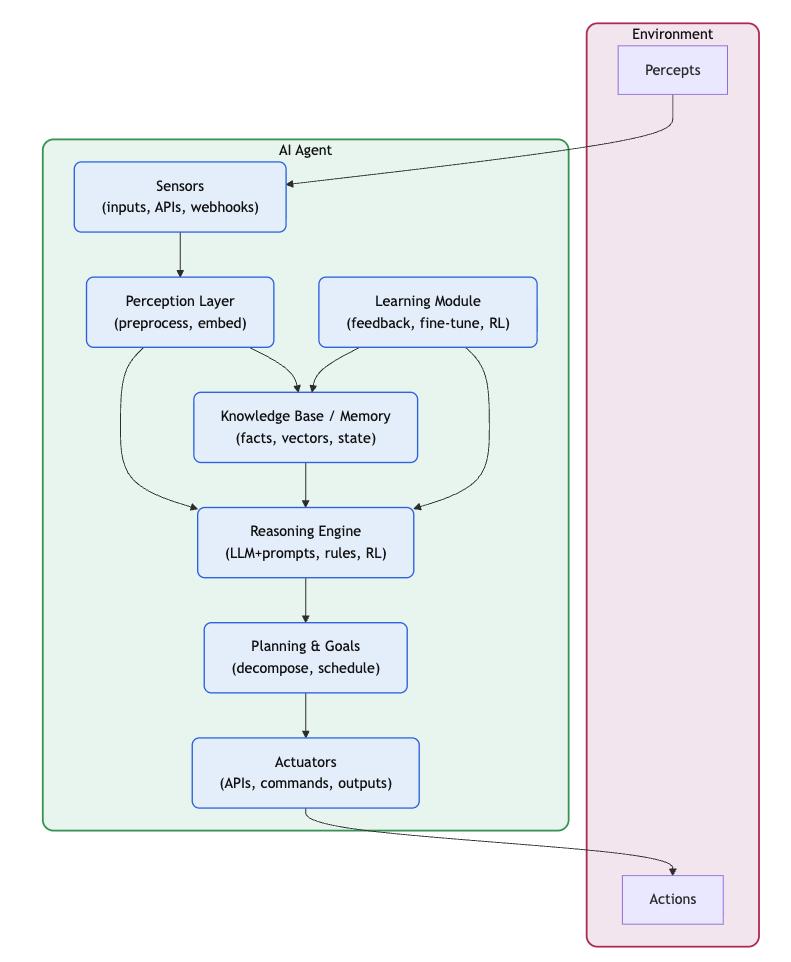
Artificial intelligence is advancing past basic chatbots and code completion. Today, AI systems can grasp context, utilize external tools, communicate with APIs, digest vast amounts of data, and execute multi-step tasks. This development has sparked the emergence of AI agents - entities built to accomplish objectives rather than merely respond to individual prompts.
An AI agent usually merges a large language model with memory, tools, and reasoning or planning capabilities. Unlike a typical query-and-reply scenario, the agent examines necessary information, picks a suitable tool, executes an action, assesses the outcome, and persists in working until the task is accomplished. For developers, this unveils a novel method of constructing applications.
For instance, an AI-enhanced customer support system can pull customer details from a database, sift through documentation, verify order status via an API, and then craft a tailored response. The language model functions as the conduit between the user and numerous software systems.
Key to these systems is Retrieval-Augmented Generation, or RAG. Rather than solely depending on what the model learned during training, a RAG system pulls pertinent data from external documents or databases and presents it to the model as context. This technique is especially beneficial for enterprises that wish AI systems to utilize proprietary or regularly updated data.
Internal documentation, product manuals, knowledge bases, technical specifications, and company policies can all be indexed and retrieved when posed a question. Vector databases play a crucial role in numerous RAG implementations. Documents are transformed into numerical representations called embeddings, which encapsulate semantic relationships between text fragments.
Upon receiving a query, the system converts the question into an embedding and locates documents with similar meaning rather than merely matching exact keywords. AI agents can also leverage tools to interact with the physical world. A developer may offer an agent access to APIs for databases, email, calendars, search engines, payment systems, or internal applications.
The agent can then discern the most fitting tool for a specific job while the application governs which actions are genuinely allowed.
Nevertheless, granting AI systems access to tools presents fresh security concerns. A system capable of reading data is markedly different from one capable of altering databases or dispatching emails. Consequently, developers must implement authentication, authorization, rate limits, input validation, logging, and human approval for sensitive operations.
Another significant challenge is reliability. Large language models can generate inaccurate information, misinterpret instructions, or opt for unsuitable actions. Hence, production AI applications require validation and monitoring mechanisms. Developers should assess response quality, monitor failures, observe latency and token usage, and develop automated evaluations for critical workflows.
The future of AI development is likely to involve a blend of conventional software engineering and intelligent systems. Developers will continue writing deterministic code for tasks necessitating predictable behavior while leveraging AI models for tasks involving natural language, reasoning, classification, information retrieval, and intricate user interaction.
Hence, AI agents are not merely replacing traditional applications. Instead, they are evolving into an additional layer of software architecture. Developers who comprehend how to combine language models, APIs, databases, vector search, security, and conventional application logic will be well-placed to construct the forthcoming generation of intelligent software.
Written by urgent.news from HackerNoon's reporting — not their text. Machine-written — may contain errors; check the original before relying on it.