Graduate Student Proves a Quantum Uncertainty Principle for Fractals
The math, which combines chaos, quantum theory, and infinitely complex fractal structures, has been called a “foundational result.” The post Graduate Student Proves a Quantum Uncertainty Principle for Fractals first appeared on Quanta Magazine
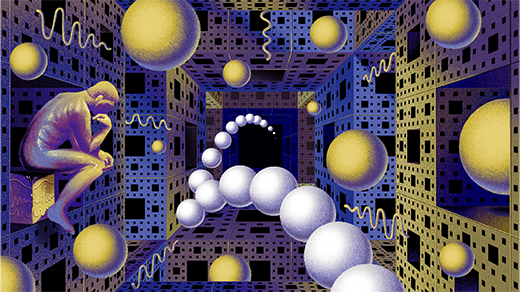
In the realm of quantum mechanics, the behavior of tiny particles often defies our intuition. One such phenomenon is the uncertainty principle, which states that the more precisely we know a particle's position, the less accurately we can determine its momentum, and vice versa. Recently, this principle has been expanded to include fractals, which are shapes that maintain their complexity regardless of the level of magnification.
Semyon Dyatlov, a mathematician at MIT, initially explored whether quantum particles behave differently in chaotic conditions. He discovered that under certain circumstances, quantum particles might become trapped in fractal-like paths. To investigate this further, Dyatlov needed a new uncertainty principle tailored to fractals.
With the guidance of Jean Bourgain, a renowned mathematician, Dyatlov successfully proved the fractal uncertainty principle for one-dimensional fractals in 2016. The following year, they organized a workshop with mathematicians from around the world to extend the proof to higher dimensions. However, the task proved too challenging, and it took years before Alex Cohen, a doctoral student at MIT, made a breakthrough.
In 2025, Cohen published his findings in the Annals of Mathematics, extending the fractal uncertainty principle to all higher dimensions, which earned him an assistant professorship at New York University at the age of 25. This groundbreaking principle has unveiled a unique way in which quantum particles differ from classical ones and has broader implications for various mathematical functions, as it is derived from the Fourier transform, an equation invented in the 19th century.
Written by urgent.news from Quanta Magazine's reporting — not their text. Machine-written — may contain errors; check the original before relying on it.