
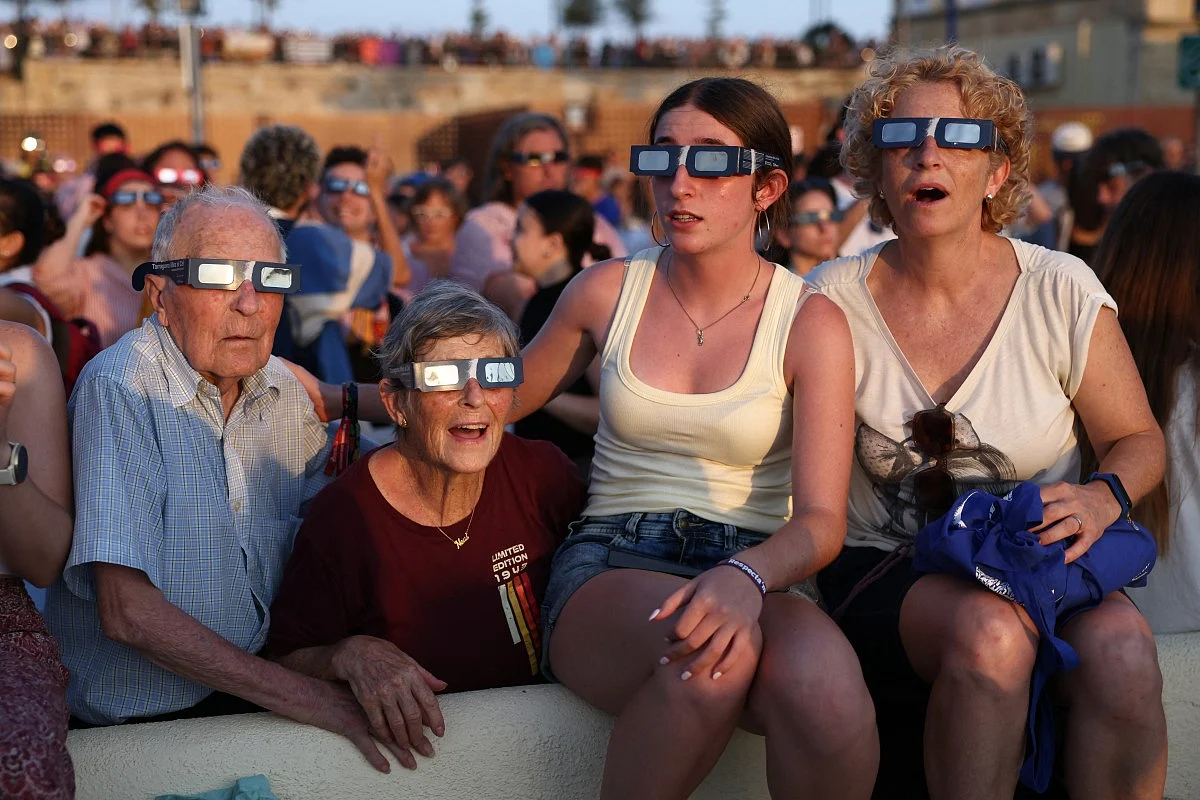
A total solar eclipse occurred in Europe for the first time in 20 years, and a NASA plane was in the skies above the UK to study the phenomenon. The total solar eclipse on April 8 was observed in parts of North America, including the United States and Mexico. However, some parts of Western Europe, including the UK, witnessed a partial solar eclipse. The National Aeronautics and Space Administration (NASA) said it flew a plane at an altitude of 26,000 feet above the UK to study the eclipse. The plane, which was equipped with a specialized telescope, took off from the UK's Brize Norton airbase. The NASA plane was equipped with a telescope capable of capturing images of the sun's corona, which is millions of degrees hotter than the surface of the sun. The UK's Met Office said there were clouds in some areas, but overall, the weather was suitable for viewing the partial solar eclipse. The Met Office added that there were a few spots where the clouds were thick, but people were still able to see a partial solar eclipse. The total solar eclipse was observed in some parts of North America, but it was not visible in other parts of the world. The last total solar eclipse occurred in Europe in 1999. The next total solar eclipse will occur in 2026. The path of totality for the next total solar eclipse will include parts of North Africa, Spain, and the Mediterranean. The solar eclipse is a rare phenomenon that occurs when the moon passes between the Earth and the sun. The solar eclipse can only be observed in a specific path on Earth. The path of totality for a solar eclipse is usually about 100 miles wide. The solar eclipse is a spectacular sight that attracts many people. The solar eclipse is also an opportunity for scientists to study the sun's corona. The sun's corona is millions of degrees hotter than the surface of the sun. Scientists are still trying to understand why the sun's corona is so hot. The solar eclipse is a rare opportunity for scientists to study the sun's corona. The NASA plane was able to capture images of the sun's corona during the eclipse. The images captured by the NASA plane will help scientists understand the sun's corona. The solar eclipse is a rare and spectacular sight that attracts many people. The solar eclipse is also an opportunity for scientists to study the sun's corona.
A total lunar eclipse, the first in 27 years to be observed across mainland Europe, took place on December 12. This celestial event was visible in parts of Greenland, Iceland, northern Russia, the North Atlantic, Spain, and Portugal. It was particularly rare for the Iberian Peninsula, having last been seen in 1912. Similarly, Iceland hadn't witnessed a total lunar eclipse since 1954. Partial eclipses were visible in most of North America, Europe, and western Africa.
The United Kingdom and France experienced a total lunar eclipse with 90% of the moon obscured. It would be 2081 before another total lunar eclipse of this magnitude is visible from the UK. This phenomenon occurs when the sun, moon, and Earth align perfectly. Despite the sun being 400 times larger in diameter and 400 times farther away, the apparent size of the sun and moon in the sky is the same, resulting in a total lunar eclipse.
However, the alignment of the Earth and moon's orbital planes is not always perfect, so not every lunar eclipse is total. Typically, a total lunar eclipse occurs every 4 years, but the exact location varies. The last total lunar eclipse visible from the Korean Peninsula was on September 2, 2035, in Pyongyang, Gangwon-do's Goseong, and some other areas. In Seoul, a partial lunar eclipse would be observable.
Total lunar eclipses are not only fascinating astronomical events, but they also provide a unique opportunity for astronomers to study the sun. During a total lunar eclipse, the outermost layer of the sun's atmosphere, the corona, becomes visible. This layer is typically hidden by the sun's bright light, making it impossible to observe with the naked eye.
The rare chance to study this extreme layer of the sun is particularly valuable for solar researchers. NASA took advantage of this opportunity by launching an observation aircraft to capture images and data during the eclipse.
Written by urgent.news from Hankyoreh's reporting — not their text. Machine-written — may contain errors; check the original before relying on it.