Watching the First Moments in a Star's Death
Astronomers were fortunate when the Einstein Probe detected the difficult-to-observe initial shock break out (SBO) from a supernova. The SBO is the first electromagnetic indication that a star is going to explode, and by observing it and the aftermath, researchers were able to determine what type of progenitor star exploded, and what it's pre-explosion environment was like.
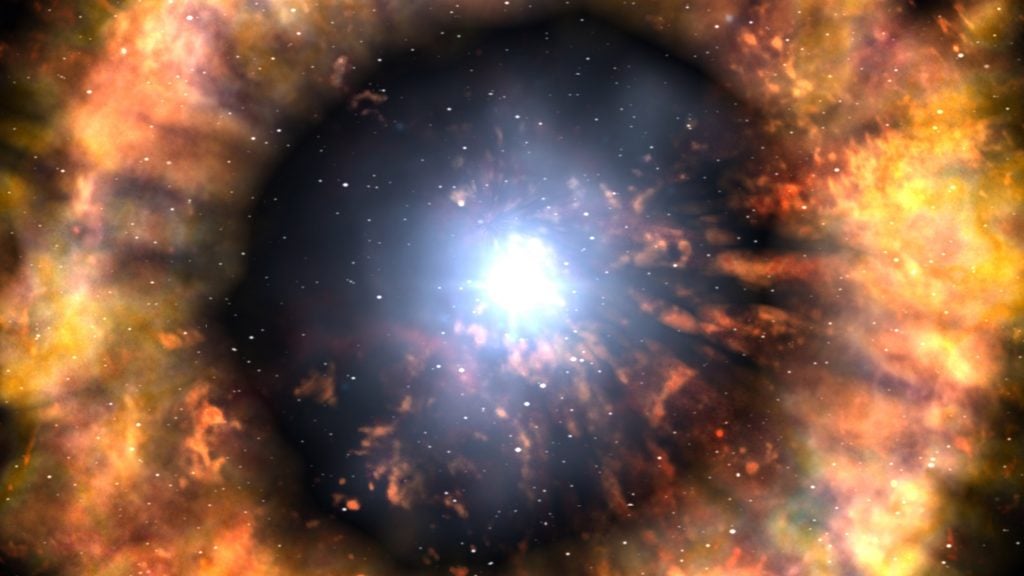
Astrophysicists have observed an x-ray breakout shock from a supernova for the second time in recent years. Supernovae create a long-lasting luminosity change that has been observed many times. However, the x-ray breakout is significant because it marks the beginning of the explosion event. The Einstein Probe, a joint mission between ESA, Chinese Academy of Sciences, and Max Planck Institute for Extraterrestrial Physics, detected the soft x-rays from this explosion in March 2026.
The flash, named EP260321a, came from a star about 500 million light years away, and triggered follow-up observations from other observatories. It was determined that this flash originated from a supernova named SN 2026gzf. Two research teams published papers in The Astrophysical Journal Letters detailing the findings. The earliest electromagnetic (EM) radiation from core-collapse supernova explosions is the shock breakout, which occurs when the radiation-dominated explosion shock crosses the surface of an evolved star.
This flash releases a bright burst that shines in X-ray or UV wavelengths and lasts for seconds to hours. Studying the earliest EM signatures of supernova explosions allows scientists to better understand the explosion, the progenitor star, and the surrounding environment. SN 2026gzf is notable not only because of its observed x-ray breakout but also because it is a broad-lined Type Ic-BL supernova, known for their relativistic jets that may give rise to gamma-ray bursts.
However, contrary to expectations, SN 2026gzf did not emit a jet or afterglow. This suggests that the jet may have been suppressed by factors such as the star's surface or the surrounding circumstellar material. The combination of observations from multiple telescopes, including Chandra X-ray Observatory, Very Large Array, Palomar Observatory, Gemini North telescope, and the Vera Rubin Observatory, provided valuable insights into the structure of the progenitor star and the surrounding environment.
This study marks the first time researchers have mapped the pre-explosion environment of a star stripped of hydrogen and helium, offering new insights into the 'lifestyle' of these stars prior to their collapse.
Written by urgent.news from Universe Today's reporting — not their text. Machine-written — may contain errors; check the original before relying on it.