Controversial health policy: Trump cuts down vaccination recommendations for children
Fewer vaccination recommendations, no combination vaccines: Donald Trump's administration is overhauling children's vaccination policy - and ignoring both exploding case numbers and scientific findings.
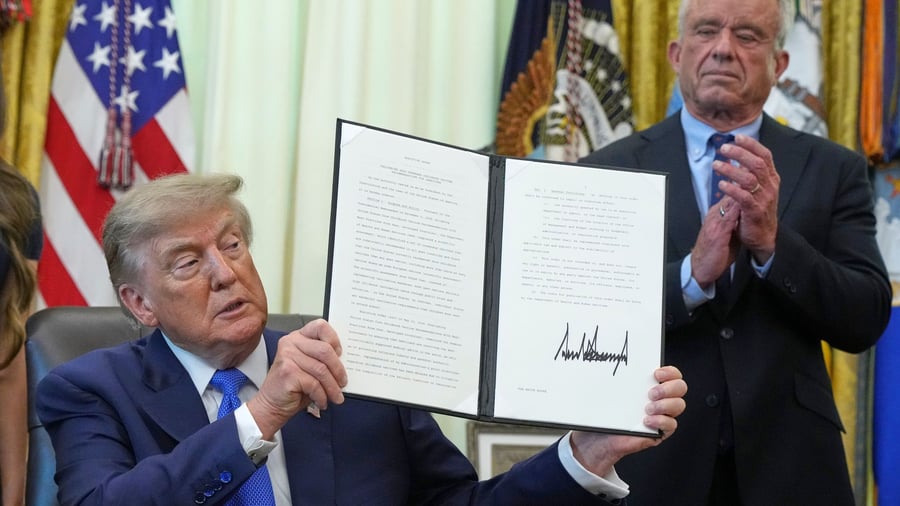
The administration of US President Donald Trump is recommending fewer vaccinations for children and wants combination vaccines to be spread out over several doctor visits in the future. By decree, Trump, in the presence of his controversial Health Minister Robert F. Kennedy Jr., ordered that from now on, only vaccinations against eleven diseases be recognized as central recommendations for all children.
It was initially unclear whether the order would have immediate effects. A similar restructuring of vaccination policy was temporarily halted by a federal court in March, and many powers over vaccination rules lie with the states.
At his appearance at the White House, the president himself admitted to relying on unproven claims. He also repeated his thesis of a possible link between vaccinations and autism, for which there is no evidence according to the World Health Organization (WHO). According to the new order, vaccinations against diseases such as hepatitis B, COVID-19, and flu will no longer be universally recommended for all children.
However, parents can continue to opt for all vaccinations, Trump emphasized at the signing of the decree at the White House. The costs of these vaccinations will continue to be covered by insurance, according to the government.
Trump called for the combined MMR vaccine against measles, mumps, and rubella to be divided into three separate vaccinations and administered at different times in the future. Together, the vaccines could be "pretty deadly," Trump said. When asked by a journalist if there was evidence for this, he replied, "No." However, he had heard from people who claimed this.
There is no scientific evidence for a particular benefit of splitting the MMR vaccine, according to the US health authority CDC. Individual vaccines against measles, mumps, and rubella are currently not available in the US.
Health experts warn that additional doctor visits could lead to children remaining unprotected for longer or later vaccinations being missed. The number of measles infections is already at its highest level in decades. In 2000, the disease had essentially been considered defeated in the US. After that, there were only sporadic outbreaks. In the past year and a half - Trump has been in office since January 2017 - there have been more cases than in the previous 25 years combined.
Studies show no link to autism. Trump again linked the new policy to the sharply increased number of autism diagnoses. He had taken his own children to several separate vaccination appointments, the president said. "I think this will have a big impact on autism." Health Minister Kennedy also said the government wanted to further investigate possible links between vaccinations, their timing, and autism.
He explained that an increase in autism diagnoses could not be explained solely by better detection and must also have environmental causes.
The World Health Organization, on the other hand, concludes after repeated evaluation of numerous studies that there is no evidence that vaccinations cause autism. A link between the MMR vaccination and autism was also not found in large studies.
The order continues the course pursued by the Trump administration for months. Kennedy had already tried to scale back the national childhood vaccination plan at the beginning of the year, issuing general recommendations only for vaccinations against 11 instead of 17 diseases and relying more on individual decisions by parents and doctors in other cases. However, a federal court temporarily halted these changes in March after medical associations sued.
In the justification for the judgment, it was stated that in the past, such decisions had been made using "methods of a scientific nature codified by procedural regulations in the law," but "unfortunately, the government has ignored these methods and thereby undermined the integrity of its actions." Trump's new order does not overturn the court decision.
It makes the reduced vaccination plan the declared policy of the government and initiates further steps but does not automatically change the currently applicable vaccination recommendations or the vaccination requirements for schools.
The latter are generally set by the states themselves in the US. Trump instructed the Justice Department to take legal action against states whose rules, in the government's opinion, violate the right to religious or medically justified vaccination exemptions.
The government points to high vaccination rates in Europe. Trump and Kennedy justified their policy by stating that European countries achieve high vaccination rates without comprehensive school vaccination requirements. Many European countries indeed rely primarily on voluntary vaccination programs. However, there are mandatory vaccinations and corresponding documentation requirements in several countries. In Germany, for example, children in daycare centers and schools must demonstrate adequate measles protection.
The US government emphasizes that it continues to strive for high vaccination rates - but wants to achieve this goal more through information and voluntary decisions by parents rather than through government regulations.
Translated by urgent.news. Machine-written — may contain errors; check the original before relying on it.