U.S. economy's K-shaped gap narrows
For years, America's economy has been defined by a "K-shaped" gap: The rich kept spending at a rapid pace, while everyone else struggled to keep up. That divide is suddenly narrowing. Why it matters: Economists warned that consumer spending growth was increasingly reliant on wealthy Americans, leaving the economy vulnerable to a stock market downturn or any other wealth shock. Importantly, the…
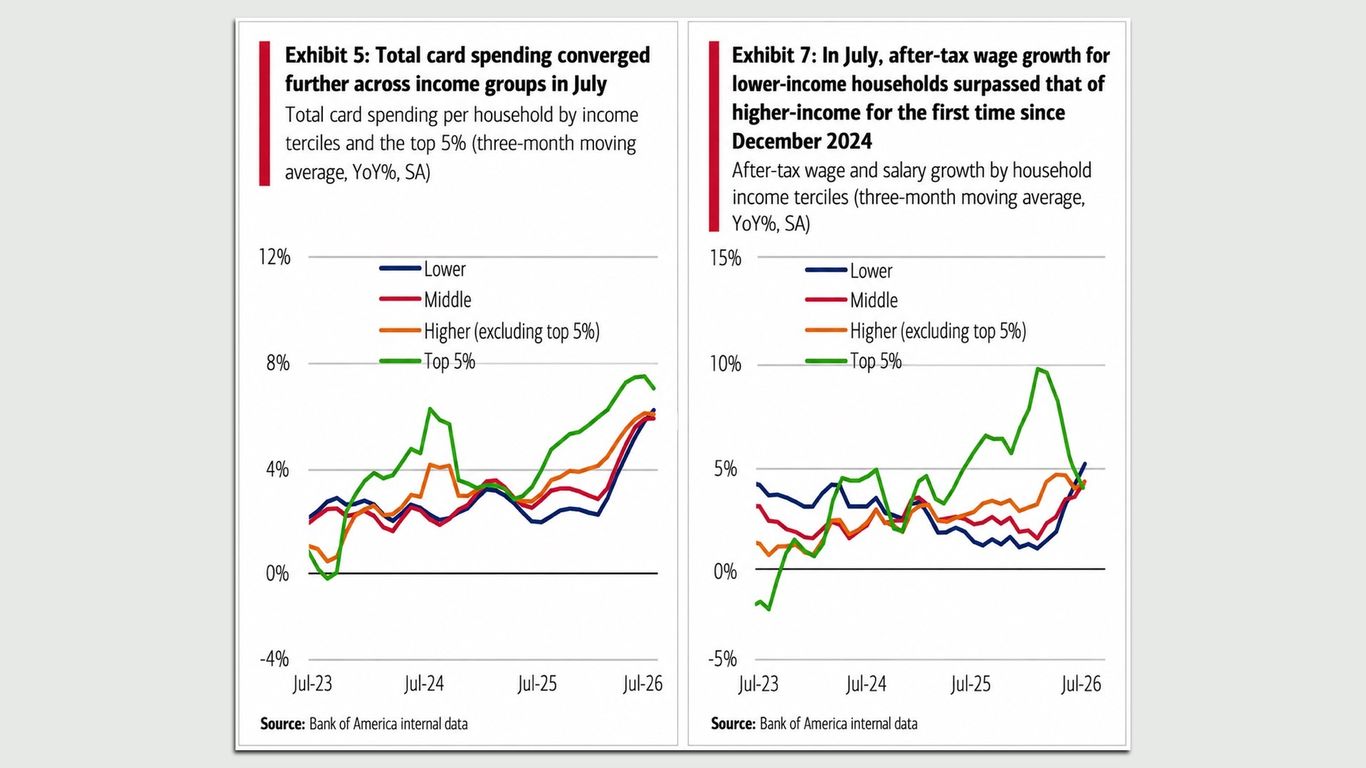
The U.S. economy has witnessed a narrowing of the K-shaped gap between rich and poor Americans. Historically, the rich continued to spend rapidly, leaving lower- and middle-income households struggling. However, this divide is now closing from the bottom up, indicating that lower- and middle-income Americans are catching up in terms of spending and wage growth.
Bank of America's data reveals that spending and wage growth among its customers have converged across income groups since May, with spending growth among lower-income households at 5.4% year over year, slightly outpacing the 4.9% rate among middle-income households. Lower-income Americans are also experiencing stronger pay gains, with after-tax wages rising 5.2% in July compared to the wage growth rate for higher-income households for the first time since December 2024.
PNC reported that the gap between spending growth among its wealthiest and poorest account holders narrowed to just 0.1 percentage point in July, down from a peak of 5 percentage points last year. The shrinking gap is largely attributed to an improving labor market, with more lower-income households working and earning paychecks, providing them with greater spending capacity.
The White House has embraced this shift, with Treasury Secretary Scott Bessent stating that the K-shaped economy is over, citing that lower-wage workers are finally catching up. However, economic sentiment among lower-income Americans remains lagging by 12 points compared to higher-income households, according to the latest University of Michigan data.
Notably, the very richest Americans continue to see spending growth outpace everyone else, even as their wage growth cools, according to Bank of America's analysis.
Written by urgent.news from Axios's reporting — not their text. Machine-written — may contain errors; check the original before relying on it.