The Under-the-Radar Creeks That Are Sweeping Carbon Out of Salt Marshes
Transport via tidal creeks is a “major and often underrecognized” pathway of carbon in the coastal wetlands, and a gap in most blue carbon assessments, new research reports.
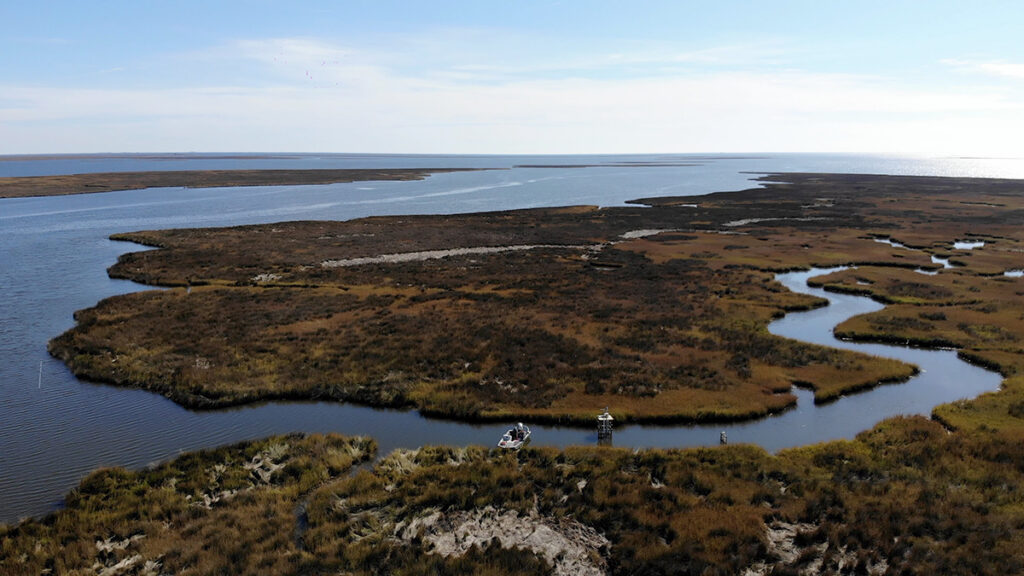
Salt marshes, coastal wetlands that experience alternating inundation and exposure by tides, are known for their significant role in carbon cycling. However, the exact mechanisms of carbon storage, transport, and release within these ecosystems remain uncertain. Researchers have now focused on a previously overlooked aspect of salt marsh carbon dynamics: the movement of dissolved carbon through tidal creeks.
These tidal creeks, which flow high or dry out depending on tide levels, can transport water and its dissolved components throughout the landscape or out to sea. By understanding this lateral carbon transport, scientists can better estimate the carbon budgets of salt marshes.
To investigate this process, researchers installed sensors to measure water flow, chemistry, and environmental parameters within a salt marsh creek in coastal Louisiana. Over the course of three years, they collected data and water samples to track dissolved organic and inorganic carbon, as well as total alkalinity. This study represents a rare, continuous dataset that captures the daily, seasonal, and annual variability of these variables.
The key finding of this research is that more dissolved carbon is exported from the salt marsh than is stored within its soils. This net flux is primarily influenced by the differences in carbon concentrations between falling and rising tides. This pattern was observed consistently at daily, monthly, and seasonal timescales, indicating that tidal creeks play a dynamic role in regulating the carbon sequestration capacity of salt marshes.
Furthermore, the study also revealed that total alkalinity, which is a measure of ocean water's capacity to neutralize acids, varies with the tides. This suggests that salt marshes can impact the acidity of downstream waters, adding another layer of complexity to their carbon cycling processes.
The authors conclude that the capacity of tidal streams to transport dissolved carbon out of salt marshes may be greater than previously thought. This implies that lateral carbon transport in tidal creeks could be a significant, underappreciated component of coastal carbon models and blue carbon assessments. By incorporating the movement of dissolved carbon into these models, scientists can improve the accuracy of coastal carbon assessments and gain a deeper understanding of the crucial role salt marshes play in the global carbon budget.
Written by urgent.news from Eos's reporting — not their text. Machine-written — may contain errors; check the original before relying on it.