The speech that redrew the lines
As Indonesia embraced Reform in 1998, BJ Habibie envisioned a military with a smaller political role. Nearly three decades later, his words have taken on renewed significance.
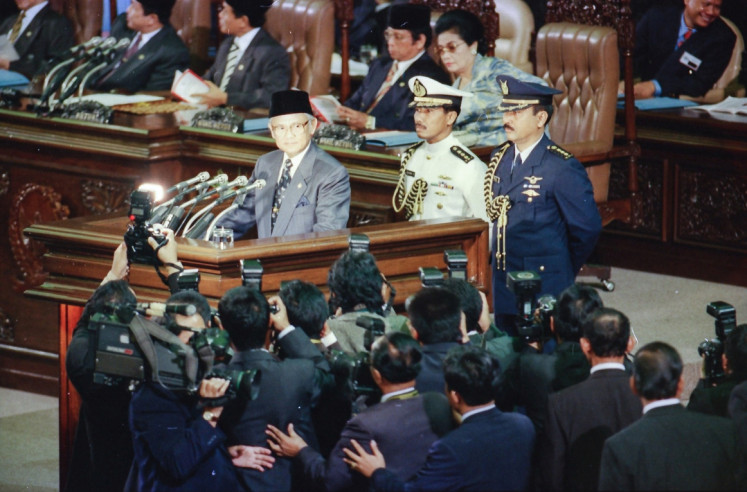
The State of the Nation address delivered by Indonesia's President BJ Habibie on August 15, 1998, marked a significant moment in the country's political landscape. Just three months after taking office, Habibie, following Soeharto's resignation, addressed the House of Representatives in Jakarta, a period still marked by economic turmoil and political unrest.
In his speech, Habibie postulated that establishing a democratic civil society necessitated a radical transformation of the military, a notion previously deemed inconceivable. The Indonesian Armed Forces (ABRI), under the New Order regime, had been operating under the dual function doctrine, allowing military personnel to simultaneously hold civilian and military positions, thereby extending their influence across various governmental branches.
Habibie emphasized the need for a new paradigm that prioritized a democratic and well-being approach, calling for the military to redefine its sociopolitical role in tune with the evolving era. His remarks were favorably received by the military leadership. The then-ABRI commander, General Wiranto, affirmed the armed forces' readiness to share political power, while Lieutenant General Susilo Bambang Yudhoyono, at that time the chief of sociopolitical affairs, acknowledged the military's outdated security approach as obsolete.
Habibie's speech played a crucial role in the eventual dismantling of the dual function doctrine, the removal of military-appointed seats in the House, and the redefinition of civil-military relations. Today, the photograph of Habibie's address seems less like a bygone relic and more a timeless inquiry posed to future generations.
The revised Indonesian Military (TNI) Law has since expanded opportunities for active officers in civilian roles and is increasingly assigning military personnel to a wider array of public duties. The question now is not where to draw the line between soldiers and civilians, but how decisively Indonesia should adhere to this line.
Written by urgent.news from The Jakarta Post's reporting — not their text. Machine-written — may contain errors; check the original before relying on it.