The Mecca Pact and America’s Reduced Leverage in West Asia
Erosion of U.S. influence could, in the long run, impact arms sales, the negotiation of military basing rights, and the management of regional crises.
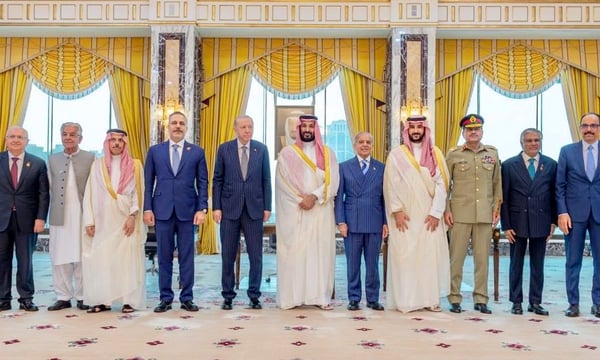
On August 7, Pakistan, Saudi Arabia, and Türkiye signed the Mecca Joint Defense Agreement, marking a pivotal moment in regional security dynamics. This pact represents the first formal security agreement formed in direct response to the U.S.-Iran conflict, reflecting the strategic adjustments made by key regional actors. The agreement stems from the crisis's profound impact on the U.S. defense umbrella, revealing its inadequacy in safeguarding Saudi Arabia and Gulf Arab states from Iranian threats.
The presence of U.S. military bases in the region inadvertently drew these states into the conflict, making them targets of Iran and its allies. Moreover, Israel's military actions against Gaza have fueled widespread discontent in the Muslim world, altering Washington's traditional role as the region's sole security guarantor.
The Mecca Pact signifies a significant erosion of U.S. leverage in West Asia, potentially influencing crucial aspects such as arms sales, military basing rights, and crisis management. While the pact does not impose direct obligations on Washington, its existing military ties with Türkiye, Saudi Arabia, and Pakistan prevent an easy disentanglement should a crisis arise.
The pact emerged from deep-rooted historical, religious, and defense ties among the signatories, whose interests have converged amid the evolving geopolitical landscape of West Asia during the Iran-U.S. war.
Historically, Pakistan and Saudi Arabia maintained strong military cooperation, culminating in a bilateral Strategic Mutual Defense Agreement last year. Türkiye and Pakistan have also collaborated on naval projects, fighter jet development, and joint exercises. Additionally, Saudi Arabia and Türkiye have forged robust defense ties, exemplified by a major defense contract in 2023 for Türkiye's Bayraktar UCAVs.
This development aligns with Saudi Arabia's Vision 2030 goal to localize over 50% of its military spending. The convergence of military cooperation among these nations facilitated the formation of the Mecca Pact, fostering deeper military integration.
For Washington, the pact's emergence is a pragmatic necessity, given the transformed regional realities where it cannot effectively ensure conflict resolution. While the agreement may not be explicitly directed against Iran, early diplomatic exchanges suggest that Iran has been kept informed and appreciative of the arrangement. The pact represents a recognition of changing perceptions in regional security dynamics, emphasizing the indivisibility of security and a potential foundation for a broader collective framework.
Iran's foreign ministry spokesman, emphasizing the threat posed by foreign reliance, views the agreement as a step towards strengthening security in West Asia.
Written by urgent.news from The Diplomat's reporting — not their text. Machine-written — may contain errors; check the original before relying on it.