Scientists aim to solve solar mystery during eclipse
A group of Irish scientists are preparing for an aerial mission during tomorrow's solar eclipse that will gather new information about the Sun.
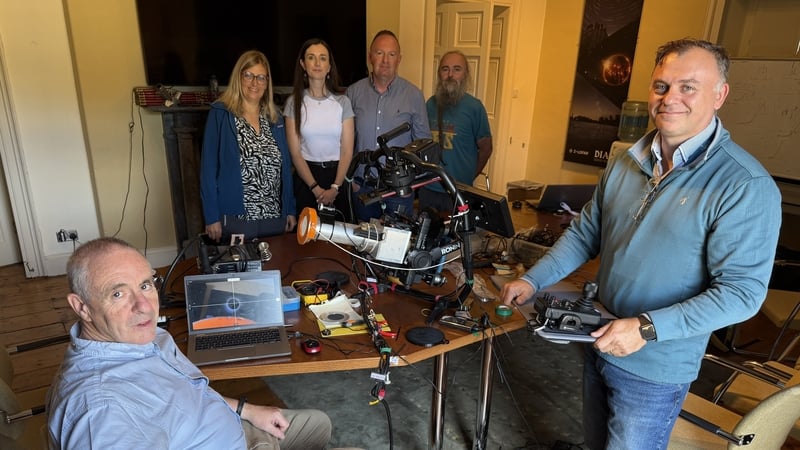
A team of Irish scientists is preparing to embark on a unique aerial mission during tomorrow's solar eclipse, aiming to shed light on one of the Sun's enduring mysteries. The group, comprising astronomers from Dublin Institute of Advanced Studies, will soar over Iceland with the assistance of the Air Corp. They are collaborating with colleagues from the European Space Agency and Italy's National Institute for Astrophysics to document the total solar eclipse and decipher its profound implications.
The Air Corps is facilitating their journey by employing a C295 Maritime Surveillance Aircraft to transport the scientists to their observation point in Iceland. Upon reaching the designated location, the plane will descend to a height of 10,000 feet, allowing the team to open a window for their specialized camera to capture clear images.
This camera, named E Cormag, has been meticulously engineered to focus on the corona, the Sun's outer atmosphere, which is typically obscured during a solar eclipse. This region has long perplexed scientists due to its extreme temperatures, reaching millions of degrees, which are considerably hotter than the Sun's surface.
Dr. Laura Hayes, an Assistant Professor at Dublin Institute of Advanced Studies, expressed her excitement and apprehension about the impending mission. She highlighted the team's rigorous preparations over the past year, including two test flights to ensure the camera's seamless operation. Hayes emphasized that they will seize every opportunity during the two-minute window to gather crucial data about the corona.
The E Cormag camera, developed with input from Italian scientists, utilizes two filters to capture images in white light and a specific spectral line—Iron 14—which unveils the corona's high temperatures. Additionally, the instrument's polarimeter allows researchers to analyze the magnetic fields by filtering light based on its polarization, providing valuable insights into the corona's complex structure.
Collaboration extends beyond Irish scientists, as the mission aims to pool resources and data from various agencies, including NASA and the European Space Agency. NASA will employ another airplane to capture images from a different perspective during the eclipse, complementing the data collected by the Irish team and E Cormag. The shared information is expected to bolster ongoing research efforts and potentially unravel the long-standing enigma surrounding the Sun's corona.
Written by urgent.news from RTE News's reporting — not their text. Machine-written — may contain errors; check the original before relying on it.