On this day in space! Aug. 11, 1960: 1st object successfully recovered from orbit
President Eisenhower inspects the Discoverer 13 capsule after its return to Earth.
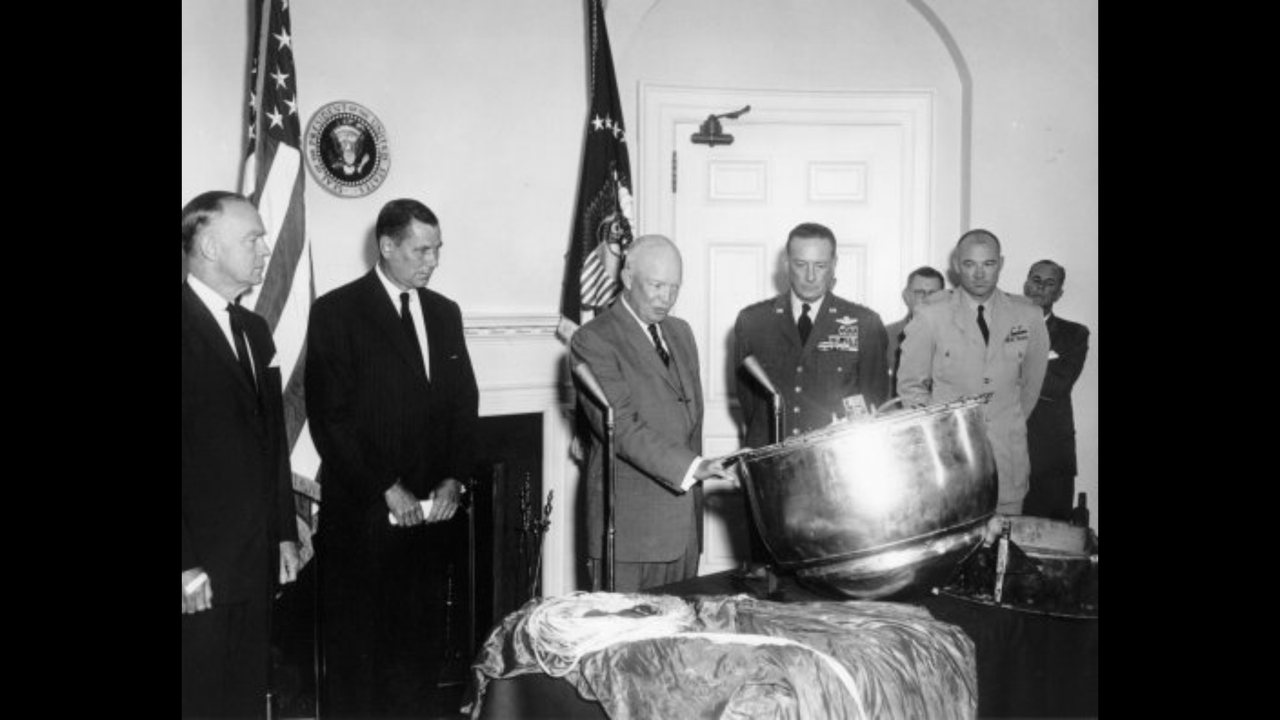
On August 11, 1960, the United States successfully recovered a human-made object from Earth's orbit for the first time. The mission was part of the CIA's Corona spy satellite program. The Discoverer 13 satellite launched by the Department of Defense was designed to return its instrument package safely and intact.
The reentry capsule, a massive bowl-shaped metal object weighing around 120 pounds, was equipped with a heat shield and parachute. As it reentered Earth's atmosphere, the capsule deployed the heat shield and parachute, allowing it to splash down in the Pacific Ocean.
A Navy helicopter quickly retrieved the capsule from the water and airlifted it to a ship, which then transported it back to Pearl Harbor. President Eisenhower personally inspected the capsule from Discoverer 13 (Image credit: Dwight D. Eisenhower Library, Public Domain).
This remarkable achievement laid the foundation for modern spaceflight. While we now take it for granted, seeing rocket stages return to Earth and astronauts traveling to and from the International Space Station, it was a groundbreaking feat in 1960. Discoverer 13 was a reconnaissance satellite built by General Electric, launched with no cameras or film on board - subsequent satellites in the series, starting with Discoverer 14, did have cameras.
The successful recovery of Discoverer 13 demonstrated that objects could not only enter space but also return safely. This milestone paved the way for future missions, enabling the return of cameras and film, which provided further insight into the process. Today, we not only return objects from space with confidence but can also bring humans back to Earth from space.
This historic milestone, though now seemingly routine, represents a significant leap forward that has allowed humanity to explore beyond what we once thought possible.
Written by urgent.news from Space.com's reporting — not their text. Machine-written — may contain errors; check the original before relying on it.