NASA Telescopes Create Colorful ‘Craft’ From Nearby Nebula
Like a collage made of layered sheets of colored cellophane, a vibrant new image layers observations of a famous star-forming nebula from NASA space telescopes. The resulting cosmic “craft” reveals new details about the star formation region known as 30 Doradus, or the Tarantula Nebula. Located in the Large Magellanic Cloud, a small neighbor galaxy […]
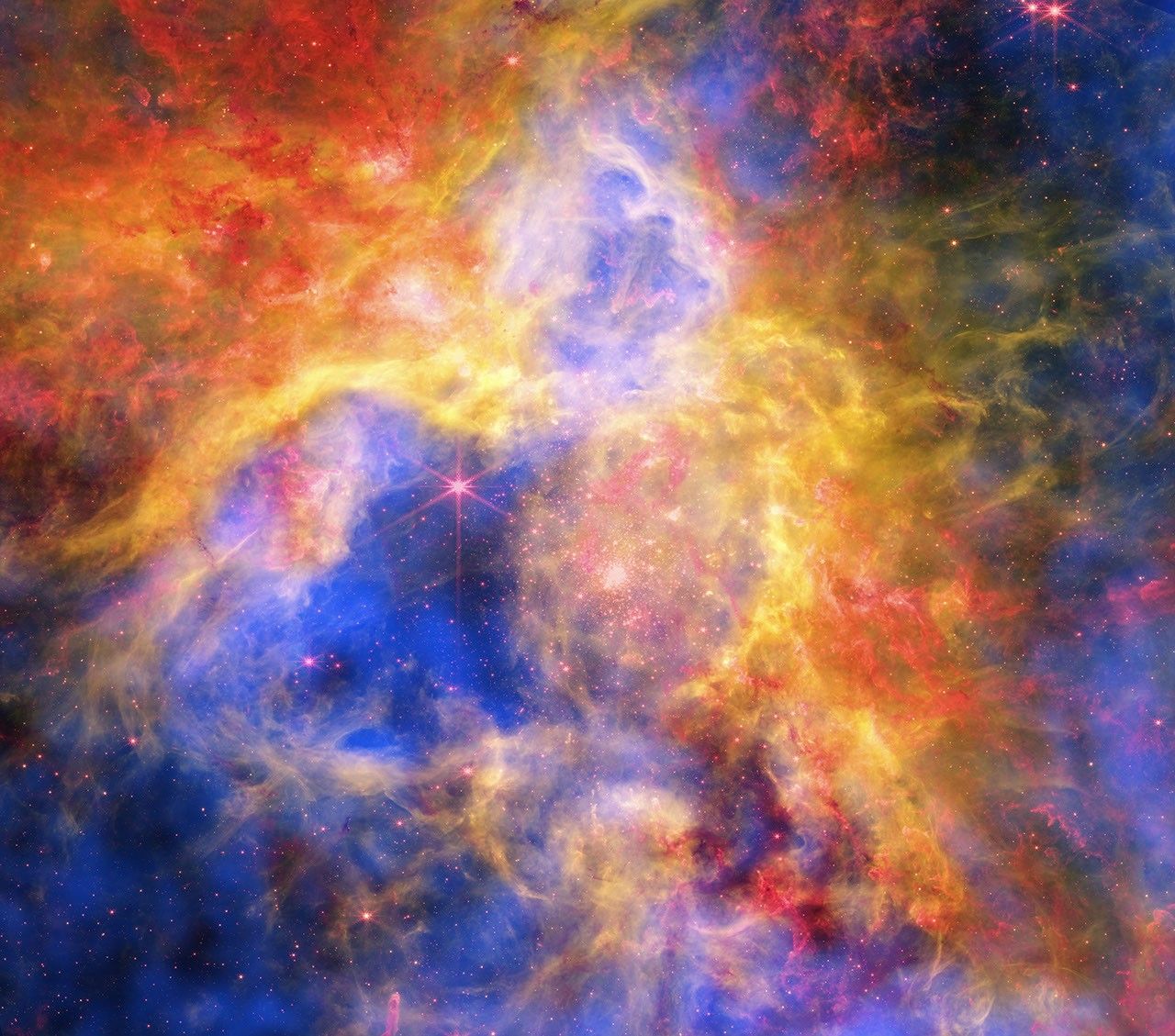
A stunning new image crafted by NASA telescopes reveals a vibrant cosmic "craft" resembling a collage of colored cellophane sheets. This composite image, created from observations of the famous star-forming nebula 30 Doradus, or the Tarantula Nebula, offers fresh insights into the region's star formation processes. The Tarantula Nebula, situated within the Large Magellanic Cloud, resides 160,000 light-years away from Earth and houses thousands of youthful stars nestled in a gas and dust honeycomb-like structure.
The image combines X-ray data from NASA’s Chandra X-ray Observatory, which has captured multiple observations of the Tarantula Nebula, displayed in blue. This layer showcases gas expelled by winds from young, massive stars, as well as heated gas heated to millions of degrees due to shock waves. The red hue in the image represents infrared data from NASA’s James Webb Space Telescope, illustrating thousands of youthful stars and layers of cool dust that will eventually foster new stars and planets.
Optical data in the green layer is derived from NASA’s Hubble Space Telescope, exposing warmer hydrogen gas and individual stars within the nebula.
The composite image presents a holistic view, displaying the Hubble and Webb images along with a substantial section of the Chandra image. Some areas exhibit the blue Chandra layer independently, while others combine it with either the red Webb data or the green Hubble data. In certain regions, all three images overlap, presenting a comprehensive perspective in red, orange, yellow, green, and blue.
Contrary to previous studies, astronomers found that the Tarantula Nebula emits less X-ray-emitting gas than anticipated. This disparity prompted researchers to explore the possible causes behind the nebula's energy loss, hypothesizing that several factors, including gas leakage, gas mixing, and conduction, may contribute to its cooling.
Written by urgent.news from NASA's reporting — not their text. Machine-written — may contain errors; check the original before relying on it.