Mining’s nameplate capacity hides a critical mineral threat: study
GEM Consulting report shows that production forecasts may overstate future supply due to risks in processing and delivery.
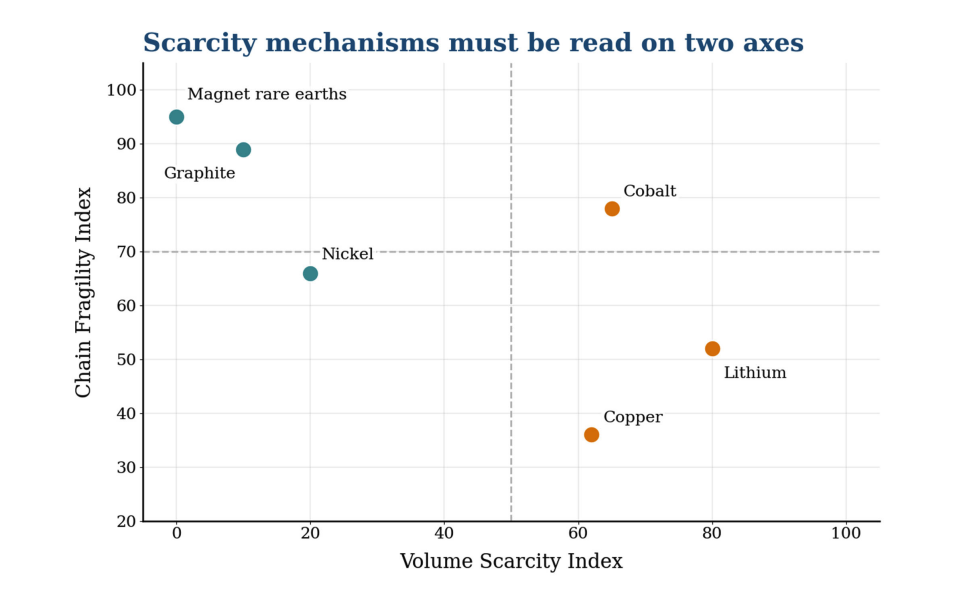
The study conducted by GEM Mining Consulting reveals that the nameplate capacity of mining operations may not accurately reflect the actual availability of critical minerals needed for the 2035 energy transition. While sufficient quantities of minerals like lithium, cobalt, and copper are expected to be mined, the actual supply coverage falls short of demand.
For instance, lithium supply covers only 68% of requirements, cobalt 74%, and copper 75%. However, the research highlights that the most vulnerable supply chains are not necessarily those with the smallest tonnage deficits. Graphite and magnet rare earths, despite projected 96% and 107% supply coverage, have the highest chain-fragility scores of 89 and 95 out of 100, respectively, indicating a greater risk of disruptions.
Lithium, on the other hand, experiences greater volume pressure, scoring 80 on GEM's Volume Scarcity Index, while copper scores 62. Cobalt combines a supply deficit with high chain fragility, scoring 78. The analysis suggests that different strategies are needed for various minerals to ensure a reliable supply. Copper, lithium, and cobalt require robust project development, while graphite and magnet rare earths need diversified processing, technology, and customer base.
The study also cautions against relying solely on announced production capacities, as they can overstate future supply. These capacities do not account for factors such as project commissioning, ramp-up, product quality, customer qualification, and operating disruptions. For example, a hypothetical project with a nameplate capacity of 100,000 tonnes could result in only 60,200 tonnes of reliable output after accounting for these hurdles.
The findings emphasize that reserves alone do not equate to supply. A mining project with proven processing capabilities, qualified products, and dependable infrastructure could hold greater strategic value than a larger resource without a viable path to customers. Ultimately, critical minerals must be financed, permitted, mined, processed, qualified, and delivered reliably to meet the demands of the 2035 energy transition.
Written by urgent.news from Mining.com's reporting — not their text. Machine-written — may contain errors; check the original before relying on it.