Climate change: Drought makes fuel more expensive – local bottlenecks possible
Above all in western Germany, fuel prices are currently tending to be higher. And if the water levels on the Rhine continue to fall, even local supply shortages are becoming more likely.
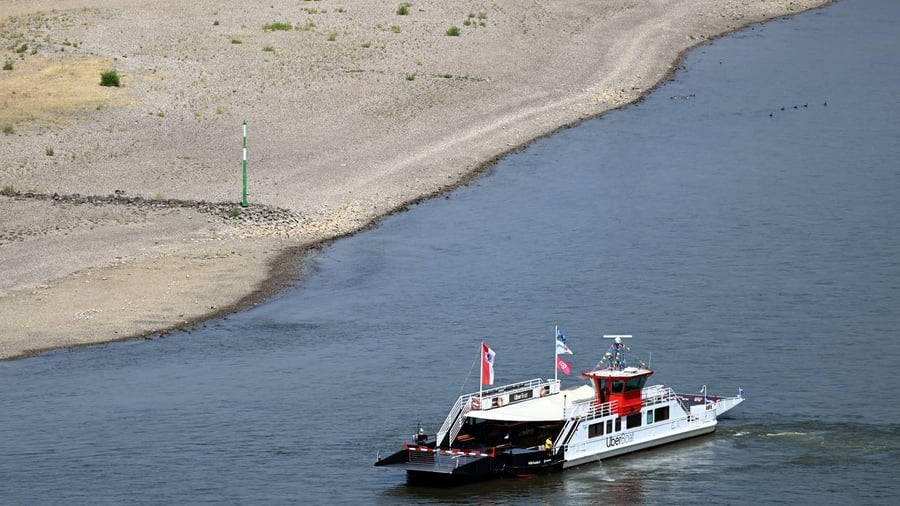
Meanwhile, motorists are also feeling the effects of the low water level in the Rhine: it is making fuel more expensive. "The current low water level on the Rhine is having a price-increasing effect," says ADAC fuel market expert Christian Laberer. However, it is only one of several factors influencing current fuel prices. The background is that the Rhine is also used as a transport route for oil, petrol, and diesel.
In large tanker ships, this is usually significantly cheaper than with comparatively small trucks. According to the expert, the current low water level is causing "the logistics costs for the transport of fuels and individual raw materials to increase significantly in some cases." In addition, the German market is not exclusively supplied via the Rhine, but via a "network of seaports, refineries, pipelines, and rail and road transport," says Laberer.
"Therefore, the low water level is likely to contribute to higher fuel prices, especially regionally." Water levels are expected to drop further There is no all-clear, however: the Fuels and Energy economic association (en2x) stated in response to a query: "According to current forecasts, however, the water levels will continue to drop in the near future, which increases the likelihood of temporary and regionally limited supply shortages.
This applies in particular if there are additional delays on the railways, technical disruptions, or other restrictions in transport logistics." Previously, the "Westdeutsche Allgemeine Zeitung (WAZ)" had reported. Basically, dealing with low water levels, especially on the Rhine, is not new for companies in the en2x association.
"Nevertheless, we are facing a major challenge. Inland vessels have to be loaded with a lower cargo volume - sometimes at a quarter of normal capacity, or they had to temporarily suspend operations altogether," the association said. Transport is being shifted to trains or trucks where possible. However, their capacities are also limited.
"This means we are seeing rising transport costs. Thanks to ongoing adjustments to logistics, the petrol station operation has so far been running at a normal level - also throughout the entire Rhine area." The member companies are "permanently working on maintaining the supply from refineries not only to petrol stations, but also with the corresponding products to heating oil customers, airports, and industry," emphasizes Managing Director Christian Küchen.
The higher costs are also noticeable in the regional fuel price distribution, as can be seen on the fuel price portal "Tankerkönig". The most expensive federal states for petrol are - as of Tuesday morning - North Rhine-Westphalia and Hesse, ahead of Bremen, Rhineland-Palatinate, and Saarland. For diesel, NRW and Hesse are in second place.
And even at the district level, it is noticeable that the expensive areas, especially for petrol, are concentrated in the western half of Germany, while it is cheapest in Bavaria - especially in its southern half. The differences are a few cents - for petrol, they are around 7 cents between Bavaria and NRW or Hesse, and around 8 cents for diesel.
The low water level, especially on the Rhine, is increasingly affecting the German economy. The Rhine is Europe's most important waterway. At low water levels, ships can take on less cargo, which increases transport costs, makes it more difficult to supply industry with raw materials, and puts pressure on supply chains. Measures against the effects of low water levels are being discussed Currently, the general renovation of the railway line on the right bank of the Rhine is also making it more difficult to shift transports to rail.
As a result, only the two tracks on the left bank of the Rhine are available between Cologne and the Rhine-Main area, otherwise there are four tracks - this exacerbates the situation. The construction work is expected to last until December. The relaxation of the truck driving ban on Sundays and public holidays in several federal states, according to the logistics association BGL, provides more flexibility for important deliveries, but no additional driver capacities.
North Rhine-Westphalia, Lower Saxony, Rhineland-Palatinate, and Saarland had already temporarily relaxed the driving ban from the previous weekend. Baden-Württemberg and Bavaria, like Mecklenburg-Western Pomerania and Schleswig-Holstein, will follow suit over the coming weekend. Saxony, however, rejects a general relaxation and refers to possible special permits.
On Wednesday, Federal Transport Minister Steffen Bilker (CDU) wants to discuss further measures against the effects of the low water level with his colleagues in the states. On Monday, he said: "We are trying to implement as much as possible to provide relief." In the short term, "we have some possibilities to hopefully get through these difficult weeks in August well," the minister continued.
Hamburg is also suspending truck driving ban due to low water levels Like other federal states, Hamburg is also temporarily suspending the ban on truck driving on Sundays and public holidays. An exemption permit is to apply until August 31, as the interior authority announced. The reason is that inland shipping is severely affected by the drought, as rivers such as the Elbe, Danube, and Rhine have low water levels.
In order to keep the logistics chains, which are necessary for the supply of citizens and the economy, reasonably stable, transports are to be shifted at least partially to the road. North Rhine-Westphalia, Lower Saxony, Rhineland-Palatinate, and Saarland had already temporarily relaxed the driving ban. Schleswig-Holstein has also suspended the driving ban. Baden-Württemberg and Bavaria and Mecklenburg-Western Pomerania will follow suit.
Translated by urgent.news. Machine-written — may contain errors; check the original before relying on it.