In 1868, an eclipse in India revealed an element found on Earth 27 years later
During the solar eclipse of 1868 in India, astronomers stumbled upon an enigmatic yellow spectral line, initially observed by Pierre Jules Janssen. Although its significance was not immediately recognized, Norman Lockyer soon named the unidentified element helium upon further analysis. Eventually, William Ramsay verified helium's presence on Earth in 1895 by extracting it from a mineral,…
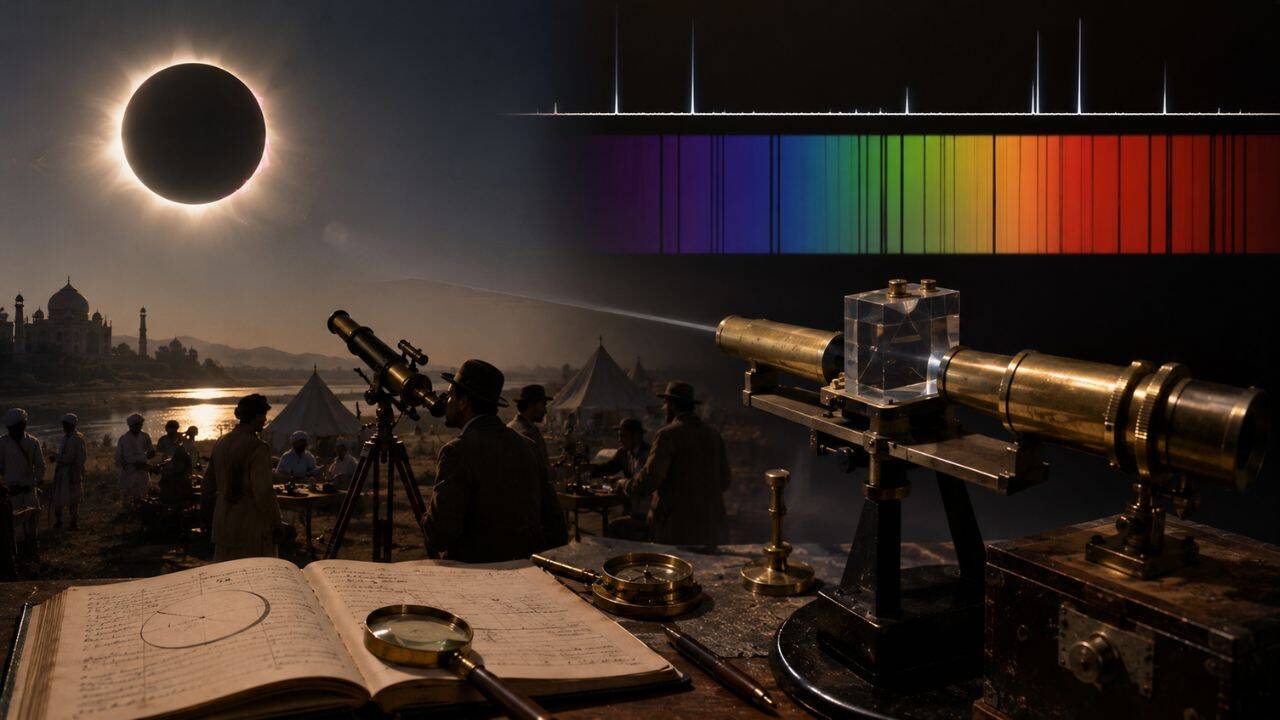
In August 1868, astronomers gathered in India to observe a total solar eclipse using a spectroscope. French astronomer Pierre Jules Janssen noticed a mysterious yellow spectral line near the familiar sodium lines, but he did not identify it as helium. The element would be recognized as helium 27 years later by Scottish chemist William Ramsay, who extracted it from the mineral cleveite.
Janssen's role was tied to his observational skill and the method he developed for examining the Sun's prominences. The yellow line became evidence for an element whose existence was inferred from solar observations, eventually leading to the discovery of helium.
Written by urgent.news from Times of India's reporting — not their text. Machine-written — may contain errors; check the original before relying on it.
This story
This is one outlet's version. Read the fullest account.
- Solar eclipse 2026: Will it be visible from India? thehindu.com