China says US tried to buy its super magnet that has ‘40% higher’ performance
A US laboratory that once dominated the field of superconducting magnets is now hoping to buy Chinese technology used in a leading particle accelerator, official Chinese media reported on Tuesday. The US Department of Energy’s Brookhaven National Laboratory once “monopolised” this type of specialised technology, according to Science and Technology Daily. But in May last year it contacted the…
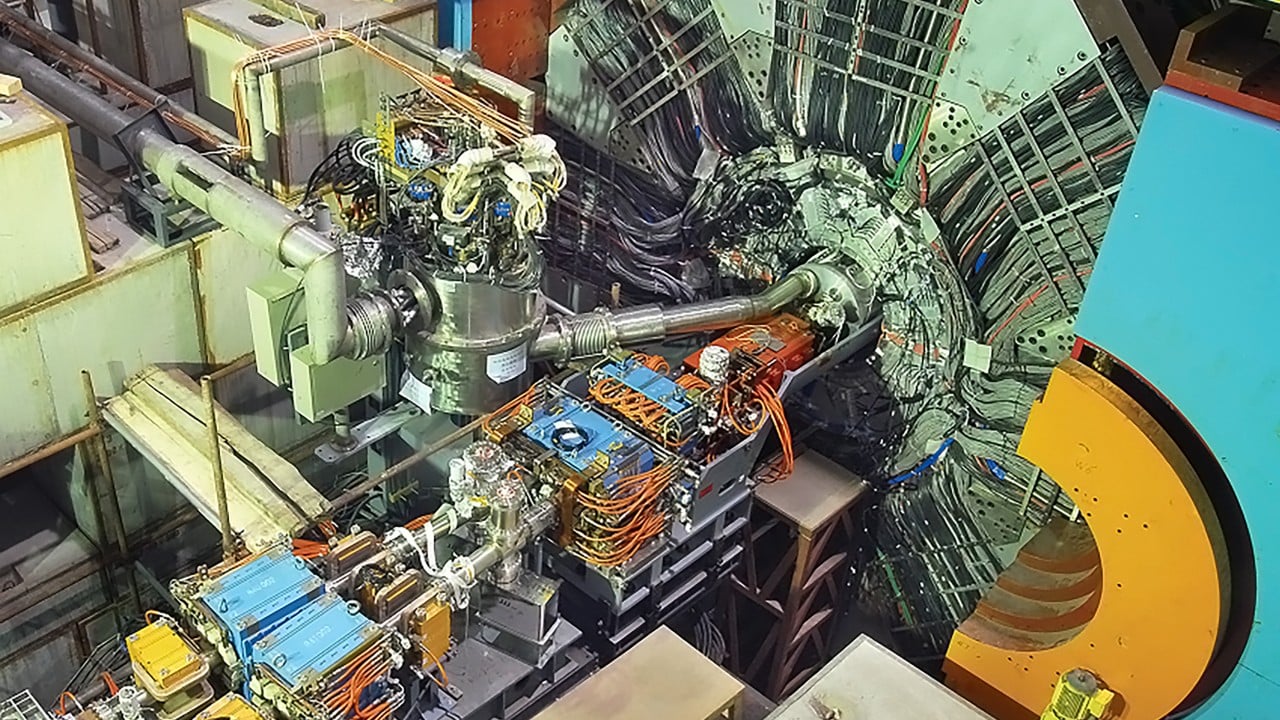
A US laboratory, the Brookhaven National Laboratory, once regarded as the top authority in superconducting magnets, is reportedly seeking to acquire Chinese-made technology used in a significant particle accelerator, according to Chinese media. In May of the previous year, the US Department of Energy's Brookhaven National Laboratory reached out to the Chinese Institute of High Energy Physics in hopes of purchasing a specific type of combined superconducting magnet, which is utilized in the Beijing Electron-Positron Collider's latest enhancement.
As of now, there is no evidence to suggest that the US lab has successfully acquired the magnet. Yu Chenghui, the chief operator of the collider, stated that China has demonstrated its ability to compete with the world's leading experts in fundamental scientific fields and has consistently achieved superior results. Zhu Yingshun, a researcher at the institute, revealed that the Chinese combined superconducting magnet is 40 percent more powerful than its American counterpart.
These combined-function superconducting magnets possess the capability to execute multiple magnetic functions concurrently. China has imposed export restrictions on specific magnets containing dual-use rare earth elements; however, superconducting collider magnets generally rely on metals like niobium and titanium instead of rare earths.
The Beijing Electron-Positron Collider recently gained attention for providing the strongest evidence to date of the existence of a glueball, a rare particle composed entirely of force. This particle had initially been theorized by physicists five decades ago but remained elusive until its recent confirmation. The collider, initially completed in 1988, has undergone two major upgrades.
The first upgrade, carried out in 2009, saw the installation of specialised superconducting magnets jointly developed by IHEP and Brookhaven, originally built and tested in the United States. The collider's second major upgrade began in 2021 and was finished last year, achieving 100 percent localisation of its equipment, according to Yu.
This success can be attributed to the promotion of independent innovation. The collider's peak luminosity, which measures the maximum rate of particle collisions per second, has now surpassed its initial design specifications, tripling the previous peak. The upgrade faced a major challenge in engineering the new magnets at both ends of the collision zone.
These magnets exhibit a more intense magnetic field gradient than their predecessors, facilitating higher collision energies. This was accomplished through the direct coil winding technology, a technique pioneered by Brookhaven, which addressed the complexities associated with the winding process. Additionally, the development of new software filled a crucial gap in China's technology for producing superconducting magnets using direct winding methods, providing comprehensive technical support for the advancement of accelerator engineering in China.
Yu highlighted that the Beijing collider currently functions solely within the tau-charm range, a critical energy region for studying fundamental particles. Since the 2009 upgrade, the collider has discovered 32 new particles, with an additional 10 to 15 predicted to be found.
Written by urgent.news from Reuters Business via SCMP's reporting — not their text. Machine-written — may contain errors; check the original before relying on it.
This story
This is one outlet's version. Read the fullest account.