Archaeologists in England Preparing for Road Construction Unearthed a Roman-Era Fingernail Cleaner With a Handle Shaped Like a Penis
The Romans considered the phallus a symbol of good luck and used it to decorate objects, mark walls and inspire sculptures
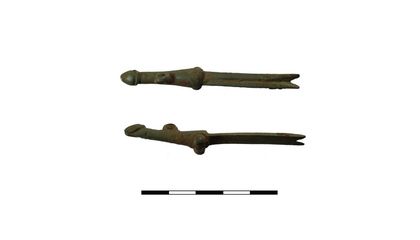
In England, archaeologists were preparing for road construction near Cheltenham when they unearthed a Roman-era nail cleaner with a handle shaped like a penis. The copper tool, likely dating to the late Roman period from 300 to 400 C.E., features a flat, two-pronged blade for cleaning fingernails and a small loop on the phallic handle for threading onto a strap or rope.
This unique object, discovered by Archaeological Research Services Ltd., is considered one of the finest examples known to researchers. While the Roman culture viewed the phallus as a symbol of good luck, warding off misfortune and bad fortune, the artifact's primary purpose was most likely functional. The discovery is part of a larger assemblage of artifacts revealing centuries of settlement, agriculture, and industrial activity in the region.
The site has also yielded remains of a fourth-century C.E. individual buried with grave goods, including a copper bracelet and coins, as well as a copper-alloy belt buckle, bronze and medieval coins, and relics from medieval and 19th-century periods.
Written by urgent.news from Smithsonian's reporting — not their text. Machine-written — may contain errors; check the original before relying on it.