Apple Vision Pro: Apple-Datenbrille: Flop im Wohnzimmer - Siegeszug im OP-Saal
Wie die Apple-Datenbrille Vision Pro Chirurgen weltweit zu schnelleren und entspannteren OPs verhilft – und warum Apple trotzdem auf den Milliardenmarkt warten muss.
Apple's Vision Pro headset, which was introduced almost three years ago, has not lived up to its promises in the consumer market. Despite a hefty price tag of nearly 4,000 euros, the device remains confined to a modest niche. Apple does not disclose exact sales figures, but it is clear that only a small number of consumers have purchased the bulky headset to experience spatial computing in their living rooms, such as encountering 3D dinosaurs.
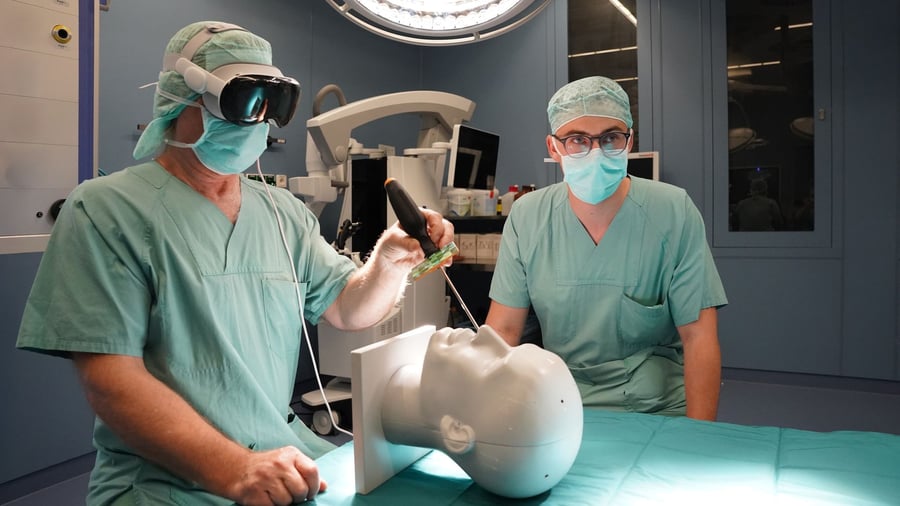
The device has found success in a different arena: hospitals. While Apple had to adjust its ambitions for the consumer market, the device is thriving in operating rooms worldwide. Medical research highlights the potential of the data glasses. An episode from Leipzig illustrates this development. In October 2023, Leipzig engineer Ronny Grunert from the Fraunhofer Institute for Tool Engineering and Forming Technology (IWU) emailed Apple CEO Tim Cook personally.
Grunert, along with Prof. Dirk Winkler from Leipzig University Hospital, presented a surgical navigation software that projects high-resolution MRI and CT data as a three-dimensional map directly into the field of view of surgeons in the operating room. Two weeks later, the response from Cupertino led the Leipzig scientists to integrate their software into the Vision Pro, participate in workshops with Apple engineers, and take home a device not yet available in Germany for further research.
This development was recently showcased at the First European Spatial Computing Healthcare Summit in Leipzig, organized by the Fraunhofer IWU and Leipzig University Hospital. Surgeons, developers, and engineers gathered to discuss the future of immersive computing in medicine. Surprisingly, the presented applications ran exclusively on the Apple Vision Pro.
In the operating room, the glasses eliminate a significant logistical and ergonomic issue. Surgeons no longer have to turn away from their own hands during minimally invasive procedures to view external wall monitors. With the Vision Pro, high-resolution live streams of endoscopes or three-dimensional patient anatomy appear directly in the natural field of view of the operator.
Professor David S. Baskin from the Methodist Hospital in Houston, Texas, a specialist in procedures performed entirely through the nose, reported that the device has become indispensable after just two surgeries. Compared to working with wall monitors, surgeons can adopt a more comfortable body posture with the Vision Pro. Additionally, Baskin appreciates the control solely through eye contact and hand gestures, eliminating the need to touch surfaces.
A study from California confirms the advantage of the Vision Pro in the operating room. Researchers investigated 32 endoscopic interventions for blocked tear ducts. Surgeons using the Vision Pro completed the operations on average after 34.4 minutes, while procedures with conventional monitor adjustments took 42.7 minutes. This 19% reduction in treatment time occurred without any complications, and surgeons reported significantly less physical and mental strain.
While the advancements in surgery are impressive, the specialized niche in operating rooms does not replace the potential for a billion-dollar market for Apple. Even if thousands of clinics worldwide equip their operating rooms with headsets, the economic impact remains insignificant compared to the hundreds of millions of iPhones or Apple Watches sold.
The Vision Pro may set new standards for medical professionals as a specialized tool, but the dream of a true next "One More Thing" for the global consumer market remains elusive.
Written by urgent.news from Handelsblatt's reporting — not their text. Machine-written — may contain errors; check the original before relying on it.