1-billion-year-old Mars meteorite found in Algeria is like nothing we've seen from the Red Planet
Scientists found a Martian meteorite on Earth that is finally filling in a nearly 2-billion-year-old geology-history gap on the Red Planet.
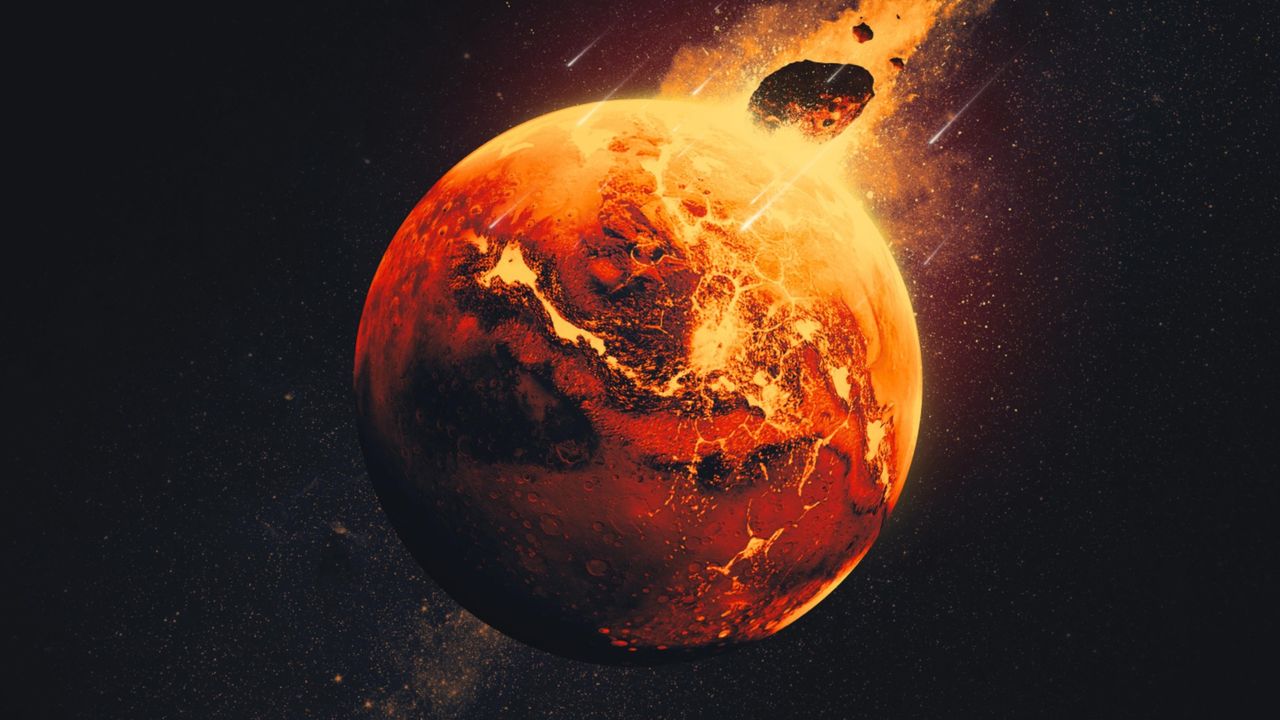
In 2019, a 1.27-billion-year-old Martian meteorite known as NWA 13441 was discovered in Algeria, though its age remained unconfirmed until recently. The meteorite's discovery has provided insights into a previously unexplored era in Mars' geological history, a time gap between 600 million and 2.4 billion years ago. This span is devoid of meteorites containing igneous shergottites, the most common type of Martian meteorites.
The meteorite's characteristics are surprising, as it is a shergottite with an age of 1.27 billion years, unlike any other known Martian meteorite. Its composition contains a rare-Earth metal called neodymium, typically found in chondrites, another type of meteorite formed during the early solar system. This blend of shergottite and chondrite hints that deeper parts of Mars have remained relatively unchanged since its formation, around five million years after the solar system's inception.
Further analysis of NWA 13441 revealed that its chondrite composition offers new boundaries on the processes that occurred in the early solar system as Mars took shape. The meteorite may have originated from an unexamined reservoir on Mars, situated between enriched and depleted shergottite sources. Scientists anticipate that examining this meteorite will provide more knowledge about the magmatic and volcanic activities that occurred on Mars.
The next step is analyzing the meteorite's isotopes to determine its relationship with other early Martian meteorites.
Written by urgent.news from Space.com's reporting — not their text. Machine-written — may contain errors; check the original before relying on it.
This story
This is one outlet's version. Read the fullest account.