Defence: €40 billion for Europe's rearmament - but partners argue over the target
Europe wants to become more independent when it comes to long-range weapons. Germany is buying Tomahawks from the US as a transitional solution - and is thus doing what the new alliance is actually supposed to overcome.
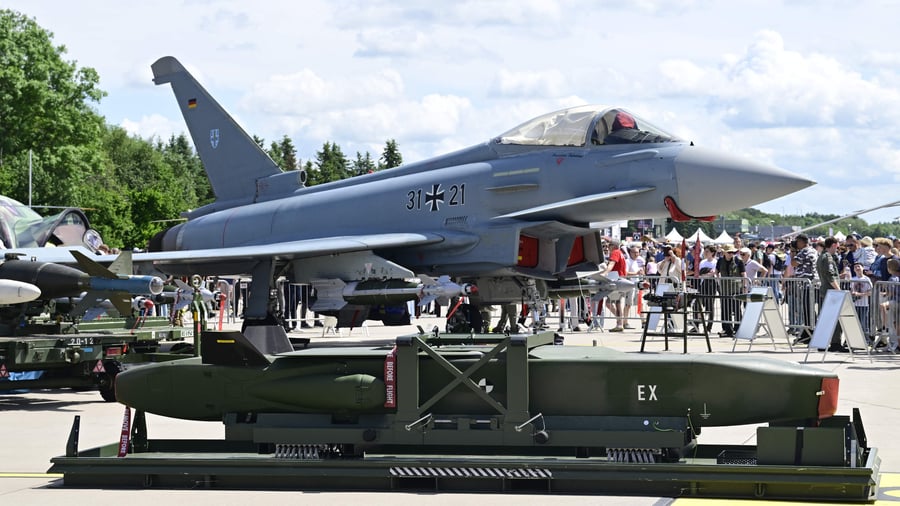
The goals are clearly defined in the public part of Germany's military strategy: "The Bundeswehr is expanding its capabilities for long-range precision effects," it says there. "At the same time, it is strengthening its ability to defend against long-range weapons and carrier systems." The aim is to be able to carry out targeted strikes against military targets even deep in the enemy's hinterland.
The military speaks of deep strike capabilities. And also to prevent the enemy from carrying out such strikes against one's own troops. Germany, like its European partners, is currently not particularly well-equipped. The deep strike capabilities are essentially limited to cruise missiles such as the Taurus, which can only fly around 500 kilometers on their own.
Not enough to impress and deter a potential opponent like Russia, because in the event of an attack, it would itself be vulnerable. "At the moment, Europe doesn't have the right weapons for that," says Sidharth Kaushal, an arms expert at the Royal United Services Institute (RUSI) in London. A number of initiatives aim to provide a remedy. As an interim solution, the Bundeswehr is purchasing Tomahawk cruise missiles from the US.
Germany wants to buy Tomahawk cruise missiles with a range of up to 2500 kilometers from the US. "We are closing an important strategic gap in our defense," said Chancellor Friedrich Merz (CDU) in early July in his government statement in the Bundestag. "And we will also work on developing our own European systems and stationing them in Europe."
One of his last official acts was for the now-resigned British Prime Minister Keir Starmer to announce one of Europe's largest armament projects at the NATO summit in Ankara in early July. Twelve countries want to invest more than 40 billion euros over the next ten years to close the gaps. The so-called "Deep Precision Strike" (DPS) project includes missiles and cruise missiles that can hit enemy targets at a distance of 300 to more than 2000 kilometers.
Germany and the UK had also agreed on the joint development and procurement of long-range weapons in a bilateral agreement last year.
And then there is also the "European Long-Range Strike Approach" (ELSA), an initiative founded two years ago by Germany, France, the UK, Poland, Italy, and Sweden. In various clusters, the project partners are working on ground- and air-based long-range weapons of different ranges, on early warning systems, but also on cost-effective disposable weapons such as kamikaze drones with a range of more than 500 kilometers.
Whether the approaches will ultimately lead to success? "While the partners generally agree on the strategic purpose of their planned DPS capabilities, there are significant differences in the technological starting level of the individual states, their defense industrial approaches to missile development, their capability goals, and the reasons for these goals," writes the International Institute for Strategic Studies (IISS).
While France sees the new medium-range missiles as a means of both deterrence and warfare, for example against enemy air defense systems, Germany and Poland primarily view the weapon category as a means of deterrence through retaliation against Russia. This has significant consequences, for example for the desired range. "The range spans from cruise missiles to ballistic missiles to hypersonic missiles," says RUSI expert Kaushal.
The choice is also a matter of cost: while cruise missiles cost a few million dollars each, ballistic weapons cost between "ten and 15 million dollars," and the unit price for supersonic missiles is around 40 million dollars.
Moreover, new programs like ELSA must be embedded in NATO's air and missile defense and compete with other weapon categories for the same defense budgets. Conflict of objectives between necessary speed and desire for more autonomy There are further conflicts of objectives. "At the technical and industrial level, the ELSA partners are faced with conflicting incentives: on the one hand, the urgency of closing a competence gap, and on the other hand, the striving to strengthen the autonomy of the European defense industry," write IISS experts Douglas Barrie, Zuzanna Gwadera, and Fabian Hinz.
"It would probably be cheaper to simply buy the new missiles in the US," says RUSI expert Kaushal - just like Germany is doing now with the Tomahawks.
Europe is also still poorly equipped to defend against deep strike capabilities. Systems like Iris-T from the German manufacturer Diehl Defence combat aircraft, helicopters, or cruise missiles at a distance of up to 40 kilometers. In Ukraine, Iris-T has already been used to intercept Russian ballistic missiles. But the American Patriot system is still considered the best in this field.
In addition, Germany has purchased the Israeli Arrow-3 system to defend against long-range missiles. To free itself from dependence on American or Israeli suppliers, ten countries, initiated by Germany, France, and the UK, formed the Integrated Anti-Ballistic Missile Coalition in July, together with Ukraine. The goal is to jointly further develop and quickly bring to mass production a defense weapon against ballistic missiles developed by the Ukrainian company Fire Point.
There is also the European Sky Shield Initiative (ESSI) in Europe, under which two dozen countries coordinate the procurement of air defense systems.
Translated by urgent.news. Machine-written — may contain errors; check the original before relying on it.