‘Unprecedented, dangerous territory’: US north-west reckons with a summer of historic wildfires
Extreme conditions in Washington and Oregon have fueled fast-moving fires, leaving the region draped in toxic plumes – and the danger isn’t over Piles of twisted metal and ashen debris line the cul-de-sacs where the tranquil suburbs of Spokane, Washington , once stood. The scale of devastation from a historic fire season of wildfire in the Pacific north-west has come into sharper focus as…
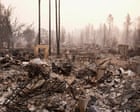
In Washington and Oregon, extreme weather conditions have led to a summer of devastating wildfires, with the region enveloped in toxic plumes. The scale of destruction has become more apparent as firefighters tackle three blazes that have destroyed at least 846 structures on the eastern side of Washington. Over 2.9 million acres (1.1 million hectares) have already burned across the two states this year, with Oregon experiencing the highest burned acreage in recorded history. Washington is now enduring its most destructive fire season.
Firefighting resources are stretched thin, but there are still months left before the dangers begin to subside. Experts predict that the threat of another warm winter will lead to even more opportunities for calamitous conditions to align. As of Friday, there were 95 large wildfires across the United States, with more than 6.3 million acres burned since the beginning of the year.
An alarming number of fires – over 45,800 – have been reported since the year began, with a hundred new fires sparking up in a single day last week.
The stage for this intense summer of fire was set long before the flames ignited. During an exceptionally hot, dry July, vegetation across the region withered away, as the NIFC's outlook revealed that large portions of Oregon and Washington received only half or a quarter of the typical rainfall. With the landscape now primed to burn, more than 600 fires ignited in a 10-day period in July, sparked by lightning and fueled by strong winds.
One of the fires in the Spokane area, known as the Old Trails fire, may have been ignited deliberately by an arsonist, leading to the arrest of a suspect.
Neighborhoods were obliterated as flames rapidly spread through the city of Spokane, one of the state's largest. The consequences of this urban conflagration echo the devastation seen in other cities, such as Los Angeles in 2025, Lahaina, Hawaii, in 2023, and the suburbs of Boulder, Colorado, in 2021. Jay Inslee, the former Washington governor, described Spokane as joining a rapidly growing list of communities devastated by these climate-exacerbated fires.
While the majority of fire activity has been concentrated on the eastern side of the Cascade mountains, a hotter and drier region than the lush rainforests and dense coastal fog of the west, Dr. Susan Prichard, a fire ecologist at the University of Washington, cautioned about the risks still ahead. Large fires in the moisture-rich areas closer to the Pacific are rare, but not impossible.
She recalled the deadly Labor Day fires of 2020, which scorched over a million acres, destroyed thousands of homes, and claimed the lives of 11 people. She expressed hope that western Washington and western Oregon would not burn, but admitted, "I hope I'm wrong. But western Washington and western Oregon are ready to burn."
The situation is not expected to improve anytime soon, with increased fire potential persisting through September. Precipitation, which could provide much-needed relief, is forecasted to be below normal through November. The El Niño climate phenomenon, characterized by warming surface temperatures in the equatorial Pacific, could further exacerbate fire risks through the end of the year, particularly in the Pacific north-west.
Models indicate a 95% chance of a very strong El Niño developing by September, potentially making it the strongest on record. The pattern has the potential to bring hotter and drier conditions to Oregon and Washington during the winter months.
Inslee warned that Washington state has never been so exposed to multiple losses, with El Niño potentially adding to the catastrophic events occurring during the summer. Globally, Europe is also experiencing a historic wildfire season, driven by deadly heatwaves that have dried out landscapes. Over 1.3 million acres have burned this year, on pace with last year's record-breaking year. Extreme heat and drought conditions are not projected to ease, and risks remain high through autumn.
Written by urgent.news from The Guardian US's reporting — not their text. Machine-written — may contain errors; check the original before relying on it.