NASA Investigative Chemistry Laboratory (NICL) Overview
Overview The NICL houses a full spectrum of state-of-the-art analytical instruments for both qualitative and quantitative analyses of non-volatile organics, volatile organics, inorganics, elements, and ions to meet diverse operational and research needs. The laboratory performs chemical analyses for identification of unknown contaminants/materials; supports failure analyses and testing for…
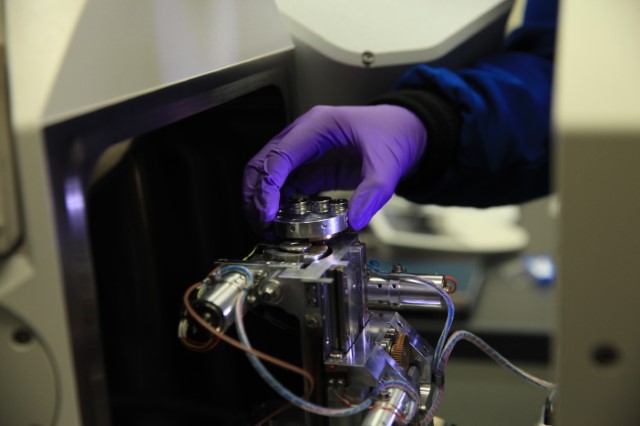
The Investigative Chemistry Laboratory (NICL) at NASA's Kennedy Space Center (KSC) offers a comprehensive array of cutting-edge analytical instruments and techniques to address diverse analytical needs. The laboratory's capabilities span qualitative and quantitative analyses of various substances, including non-volatile organics, volatile organics, inorganics, elements, and ions.
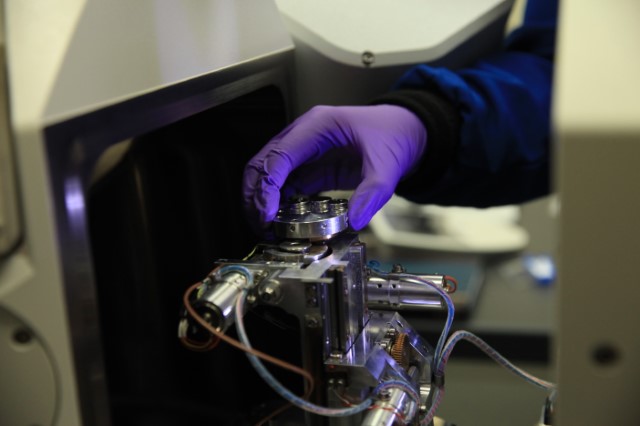
NICL is equipped to identify unknown contaminants and materials, support failure analyses and testing for multiple programs, and provide real-time problem solving, testing, and support to a range of NASA and KSC initiatives. The laboratory utilizes a variety of microscopic techniques, such as scanning electron microscopy (SEM) and energy dispersive spectrometers (SEM/EDS), to conduct high-resolution imaging of samples, both coated and nonconductive, enabling the analysis of elemental composition and material form and structure.
In addition to microscopy, NICL employs complementary instrumentation for the analysis of organic and inorganic samples. This includes Fourier transform infrared spectrometry (FTIR), dispersive Raman spectrometry, and x-ray powder diffraction (XRD) systems. The laboratory also offers analytical services for solid, liquid, and gas samples, utilizing instruments such as an inductively coupled plasma optical emission spectrometer (ICP-OES), inductively coupled plasma mass spectrometer (ICP-MS), spark OES, carbon/sulfur (C/S) analyzer, microscopic x-ray fluorescence and portable x-ray fluorescence (XRF) spectrometers, ion chromatographs for anion and cation analysis, high performance liquid chromatograph (HPLC) with various detectors, and a cryogenic preconcentrator for trace-level gas detection.
Written by urgent.news from NASA Science's reporting — not their text. Machine-written — may contain errors; check the original before relying on it.
This story
This is one outlet's version. Read the fullest account.