Berlin gold hat: A 3,000-year-old ceremonial headdress that a cult used to track the sun, moon and lunar eclipses
The pointy gold hat reveals evidence of a Bronze Age sun cult whose leader could predict eclipses.
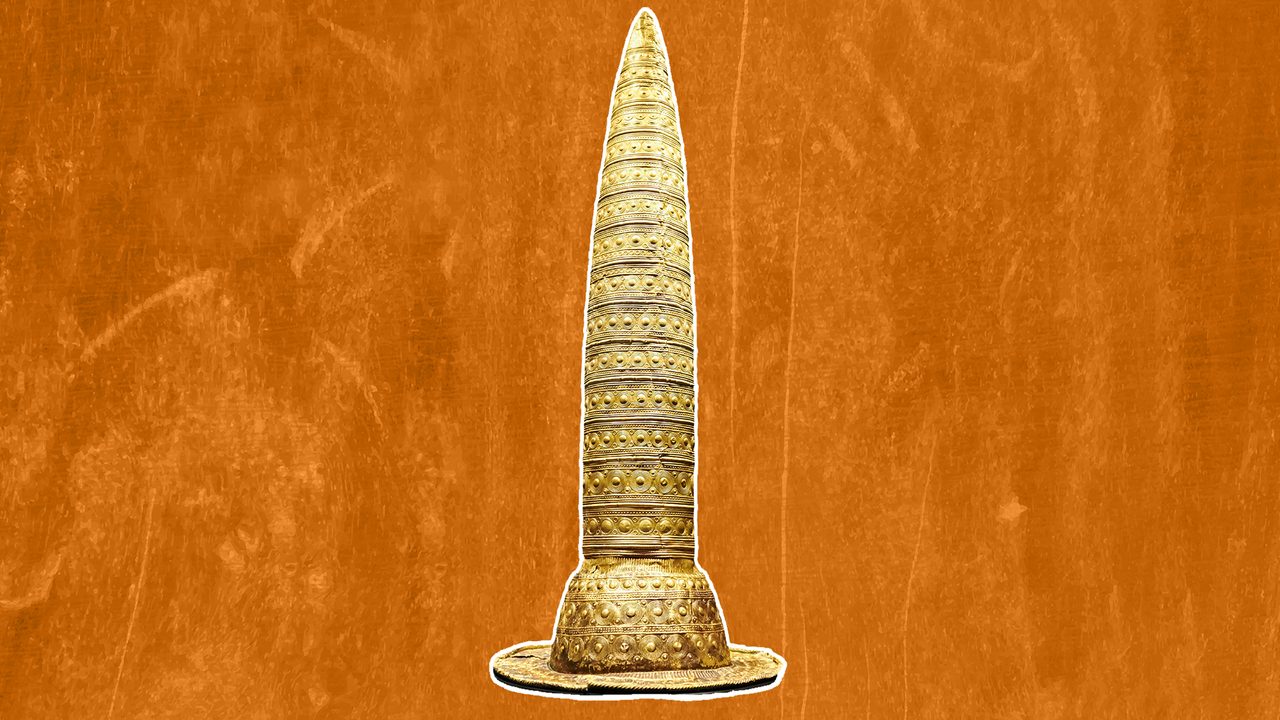
The Berlin gold hat, a 3,000-year-old ceremonial headdress, was crafted from a single sheet of hammered gold and adorned with motifs that encode a calendar. Likely originating from southern Germany, the artifact is believed to have been worn by an ancient priest during sun cult ceremonies. The museum in Berlin, where the hat is currently housed, acquired it in 1996, though its original discovery location remains unknown.
The hat stands 29 inches tall and weighs just over a pound, featuring a bronze band rimming its brim. Intricate decorations, including concentric circles, disks, and ovals, encode numerical values that enable calculations related to lunar and solar dates, lunar months, solar years, and even the prediction of lunar eclipses. According to Matthias Wemhoff, director of the Museum of Prehistory and Early History, the individual who wore this hat possessed secret and highly specialized knowledge, serving as a priest at sunrise as the sun's golden rays illuminated the ceremonial space.
While there are no historical records of a Bronze Age sun cult in Europe, similar artifacts like the Trundholm Sun Chariot and the Nebra Sky Disk underscore the significance of celestial bodies in prehistoric societies.
Written by urgent.news from Live Science's reporting — not their text. Machine-written — may contain errors; check the original before relying on it.