Mount Toba eruption doesn't seem like it could nearly kill our species
The massive Toba eruption seems to have had little climate impact.
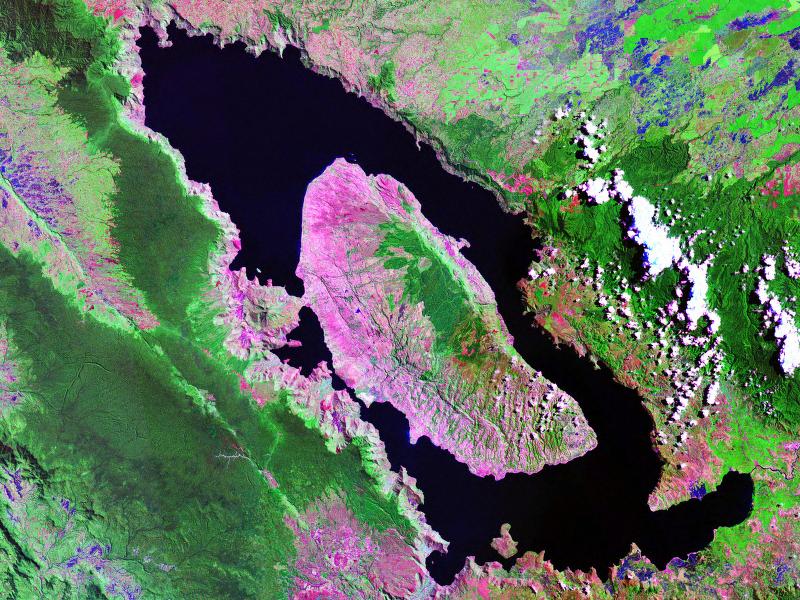
Mount Toba experienced the most powerful volcanic eruption in the past 2.6 million years. Some scientists hypothesized that this cataclysmic event nearly led to the extinction of the human species. Approximately 74,000 years ago, a caldera in Sumatra emptied thousands of cubic kilometers of magma over two weeks, ejecting magma roughly a thousand times more than the 1991 Mount Pinatubo eruption.
Geoscientist Jinheum Park from Johannes Gutenberg University in Germany and his team examined mud samples from a small crater lake bordering Kenya and Tanzania, hoping to discover evidence of this ancient catastrophe. However, their findings revealed that the impacts of the Mount Toba eruption only lasted for under two years and may have caused a cooling of the Earth's surface by approximately half a degree.
Volcanic eruptions release sulfur dioxide into the stratosphere, where it forms a haze of tiny particles that reflect sunlight back into space, leading to cooling. Larger eruptions eject more sulfur dioxide, theoretically causing greater cooling. However, this relationship breaks down when the eruption exceeds a certain magnitude, as larger sulfate aerosols settle more quickly due to their heavier weight, making them less effective in scattering incoming solar radiation.
Written by urgent.news from Ars Technica's reporting — not their text. Machine-written — may contain errors; check the original before relying on it.
This story
This is one outlet's version. Read the fullest account.