Building Lexi.AI: A Local-First Architecture for Sovereign AI
Explore how Edge AI and data sovereignty can power private personal assistants with local inference, encrypted memory, and user-owned data.
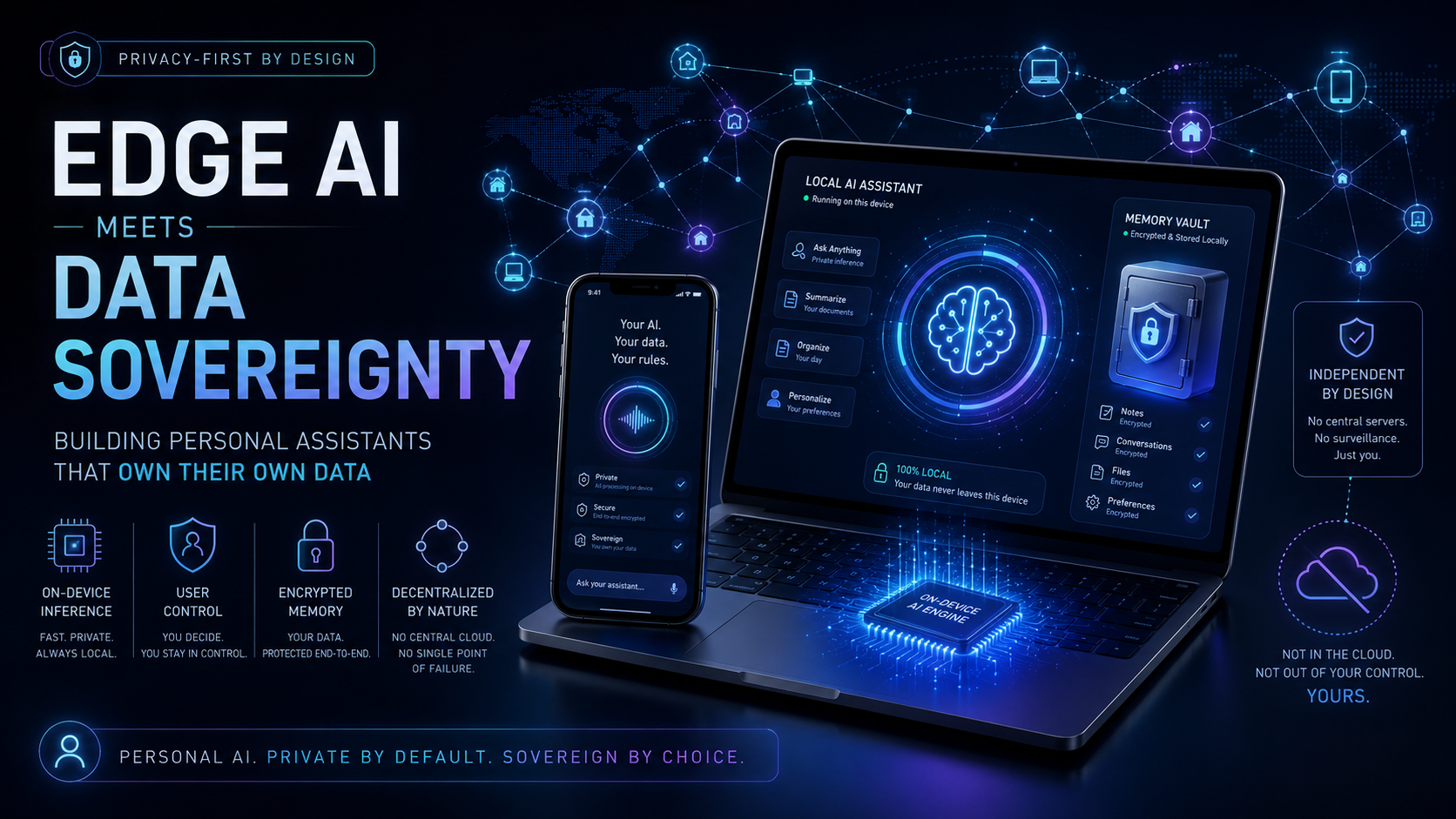
The current AI services are dominated by a limited number of large cloud providers. These companies host the language models, perform the inference, and retain all user interactions for training purposes. This model creates a growing "compute debt" for businesses, as each new feature adds hidden costs that are difficult to predict due to opaque pricing and hidden API quotas.
On the user side, every input request poses a privacy risk, and compliance teams struggle to demonstrate that personal data never leaves its home country. According to a June 2024 European Data Protection Board report, 42% of AI-driven consumer apps inadvertently breached GDPR by storing conversation logs in non-EU regions. Attempts to mitigate these issues by moving to private clouds or encrypting data at rest are merely superficial band-aids.
They merely add a layer of obfuscation without addressing the core problem. The real key to a truly private AI system lies in local execution: running the model directly on the user's device, keeping all data within the device's Trusted Platform Module (TPM), and allowing the user to audit the entire software stack. This requires a modular architecture that can also utilize decentralized compute resources when local resources are insufficient.
Lexi.AI is a prototype that demonstrates this approach. It consists of three layers: edge inference on the device, encrypted personal memory, and optional peer-to-peer GPU offloading. The edge runtime uses Hugging Face Transformers compiled with torch-mlir for efficient WebGPU acceleration. For devices without a GPU, llama.cpp offers 4-bit quantized inference that fits within 2GB of RAM.
To ensure user data remains confidential, Lexi.AI employs secure enclaves like Apple's Secure Enclave or AMD's SEV to encrypt the user's conversational memory. Facts are stored as entity-relation-value triples in a locally indexed "Self-Stored Personal Knowledge Graph," enabling fast local retrieval. When the request exceeds the local compute budget, Lexi.AI can offload the task to a federated job on the Nosana network, which uses Flower for secure gradient aggregation, ensuring only gradient updates, not raw user data, are transmitted.
Permission prompts allow users to choose which nodes to trust, with all communications encrypted using post-quantum TLS. Model updates are handled through LoRA adapters, ensuring the base model remains unchanged on the device and only lightweight patches are applied, reducing network traffic and attack surface. The entire system is open-source, with a CI pipeline that builds reproducible Docker images for various edge targets (ARM64, x86_64, WebAssembly), allowing CTOs to audit the binary supply chain easily.
The benefits of this architecture are significant. For product teams, it can reduce cloud costs by up to 60% for low-latency features, as demonstrated by a University of Cambridge field study on on-device speech transcription in July 2024. Developers gain a safe sandbox to experiment with new prompts without fear of data leakage.
From a policy perspective, the architecture provides a clear path to compliance, as data never leaves the jurisdiction and cryptographic attestation logs can prove it. Overall, Lexi.AI offers a smarter, more privacy-conscious assistant that respects users' budgets, privacy, and regulatory obligations. However, there are still open questions.
The economics of peer-to-peer GPU rental at scale is uncertain, as real-world usage spikes could lead to price volatility and unpredictable market behavior. Another challenge is designing permission prompts that do not overwhelm users, as excessive friction could push them back to centralized services. Additionally, testing the robustness of encrypted memory against side-channel attacks on heterogeneous hardware is an ongoing effort.
Looking ahead, the vision is for every smart device, from smartphones to AR headsets and industrial sensors, to host a personal AI that understands users' preferences, work context, and compliance requirements without ever sending data to cloud providers. This shift will transform the global compute market from a few monopolistic clouds to a diverse ecosystem of trusted nodes offering verifiable GPU cycles.
In this future, data breaches will be rare, and AI ethics committees can focus on higher-level governance rather than dealing with data privacy incidents.
Written by urgent.news from HackerNoon's reporting — not their text. Machine-written — may contain errors; check the original before relying on it.