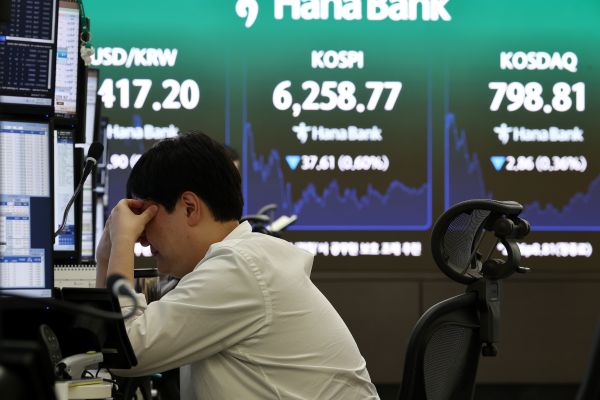
1600원 위협하다 어느새 1300원대 눈앞…환율도 ‘롤러코스터’
Over a month ago, the won-dollar exchange rate had surged to the mid-1500 won range. However, it has quickly plummeted to the 1300 won vicinity now. The monthly fluctuation rate has averaged 47 won this year, the largest since 2009. According to the Bank of Korea's economic statistics system, the average monthly change in the won-dollar exchange rate, based on the 3:30 PM weekly trading price, was 47.0 won from last month's end.
This is the highest level since 2009, the year of the financial crisis. The previous monthly exchange rate fluctuations exceeded 40 won only during the 1997 financial crisis (72.2 won), 1998 (97.6 won), 2008 (68.3 won), and 2009 (61.2 won). Looking at a month-by-month breakdown, the Korean won initially dropped 90.4 won following the outbreak of the US-Israel-Iran war on February 28th, then fell 46.8 won in April due to expectations of US-Iran negotiations.
Subsequently, it dropped 24.6 won in May and 41.5 won in June amid large-scale foreign stock sales and ongoing Middle East tensions. In July, it plummeted a staggering 125.4 won. Recently, the rate of decline in the exchange rate has been even faster compared to last year's April-June, when the impact of custom tariffs was minimal.
The won-dollar exchange rate peaked at 1555.8 won on July 2nd before falling 139.7 won over the last 25 trading days. Day-to-day average losses totaled 5.6 won. As of 6 AM on August 8th (24-hour trading system), the latest trading session concluded at 1409.5 won. This day's lowest price (1407.3 won) was the lowest since October 2nd last year (1399.5 won).
While the dollar selling spree continues, driven by the dollar sell-off, the won has dropped to its lowest level in 10 months. A key factor behind the recent largest monthly exchange rate fluctuations since the financial crisis is the drastic change in the foreign exchange supply situation. SK Hyunsung's ADR (American Depository Receipt) fund inflow and the resulting shift in the supply direction of won to dollar caused the won to rapidly fall into the 1400 won range.
The US employment data released last week, which was worse than expected, raised doubts about the Federal Reserve (Fed) raising interest rates within the year. This has led to a decline in the dollar index, which measures the value of the dollar against six major currencies, falling to a low of 99.399. Businesses are managing their currency risks with "sweat equity."
With the won appreciating, inflation pressure would decrease and foreign exchange market stability would improve. However, the rapid decline in the exchange rate has resulted in uncertainty and currency loss for both export and import businesses. IMF economist Kim Ae-hyun said that exporters who postponed their dollar sales due to the expected rise in the exchange rate may have missed some sale timing.
Import businesses also experienced currency loss if they anticipated a rise in the exchange rate and took positions in currency futures.
Written by urgent.news from Hankyoreh's reporting — not their text. Machine-written — may contain errors; check the original before relying on it.