Real Estate: Solar Subsidies: That's What's Still In Store for Property Owners
It was initially supposed to be completely over. But now there won't be an immediate funding stop for small solar systems. What sums are still possible for the feed-in tariff.
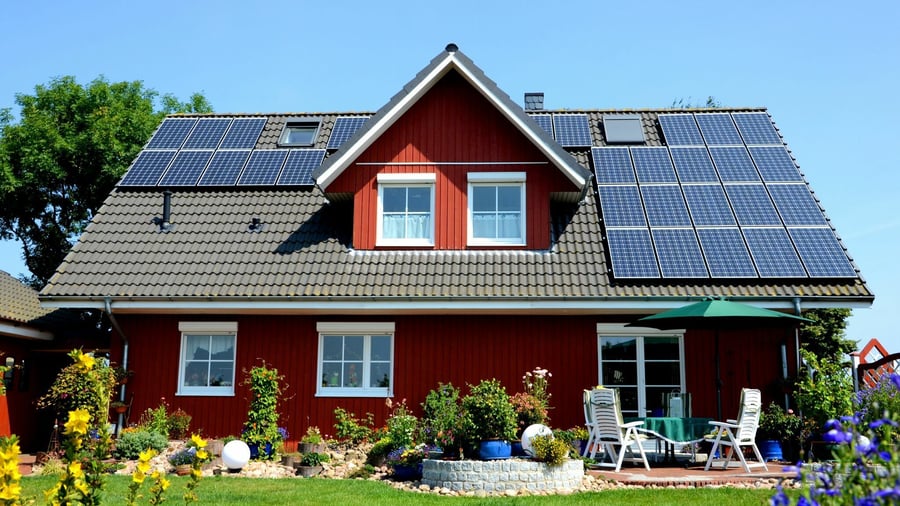
Anyone interested in installing photovoltaic systems on their roof should become active soon. In July, Federal Minister of Economics Katherina Reiche (CDU) had weakened her original plans for cuts in the promotion of renewable energy at several points. Since then, it has been clear that there will be a fixed feed-in tariff of up to 20 years for systems that are put into operation by the end of the year.
The Federal Network Agency has published details on the exact tariffs, the size of the systems, and the timetable for when there will be less.
Since August 1, new rates have applied to the feed-in of solar power into the public grid. These are based on the time of commissioning and the installed capacity of the solar system. For example, if a new system with a nominal output of up to ten kilowatt-hours is installed in the coming months, the only question to be answered is whether part of the generated electricity is consumed oneself and the rest is fed into the public grid, or whether everything is passed on.
There is a clear trend. "On average, homes supply themselves with 70 percent of solar power," according to experts at the University of Applied Sciences (HTW) Berlin in a study.
Differences in full and partial feed-in
For partial feed-in with a system with up to 10 kW of installed power, there are currently 7.7 cents per kilowatt-hour (kWh), for full feed-in 12.2 cents/kWh. The tariffs shrink for larger systems, with further limits at 40 kW and 100 kW. For larger systems, there is no funding under the Renewable Energy Act (EEG).
A general funding stop for newly installed systems, as originally considered, will not apply from next year. However, from then on, the transition from a permanent feed-in tariff to a limited transitional payment will begin. This will apply from 2027 for systems under 50 kW, from 2028 for less than 25 kW, and in 2029 and 2030 for under seven kW. From 2031, there will be no more transitional payment.
The transitional payment starts at 5.2 cents/kWh and decreases every six months. The goal is to make feed-in less attractive for homeowners so that they consume the generated electricity themselves. Furthermore, direct marketing, i.e., the sale via the stock exchange, should also increase for smaller systems under 25 kW. For this, there will be a direct marketing bonus of 1.5 cents/kWh, limited to 48 months.
However, the Federal Cabinet has approved the EEG amendment on July 29, but this is not yet in force. The Bundestag and Bundesrat will consult on it after the summer break. The EU Commission must also approve the aid approvals. Some things can still change. The law is scheduled to come into force on January 1, 2027.
KfW credit also possible for battery storage
However, the feed-in tariff is not the only reason to purchase a photovoltaic system now. Cheap loans and regional grants should also be considered in the decision. The KfW credit program with the number 270 is considered a flagship product in financing. With this, the total sum of the project can be financed, i.e., in addition to the acquisition, also the costs for planning, project planning, and installation.
In addition, battery storage, which is particularly important for self-users of the generated electricity, can be covered.
The effective annual interest rate depends on the term, interest rate, and interest-free start-up period. In the best case, it is currently 4.07 percent with a term of five years and an equally long interest rate. Particularly interesting: A complete project can also be financed over 20 years with an equally long interest rate. Without an interest-free start-up period, the effective annual interest rate is currently 4.99 percent.
Tax benefits also apply to the purchase. For smaller systems up to an output of 30 kW, no value-added tax has been payable for purchase and installation for three years, the same applies to battery storage. Their prices have fallen sharply in recent years, so that nowadays, a photovoltaic system usually includes a battery storage system.
Grants from states and municipalities
There is no direct financial funding from the federal government for the installation of a photovoltaic system. However, many states and municipalities offer regional programs that can make the purchase cheaper. For example, Berlin promotes solar systems on homes, including storage, with the "Solar Plus" program. In Hamburg, there is the "Hamburger Dachbegrünung" program for the combination of solar systems and green roofs.
Baden-Württemberg supports with low-interest loans under the "Wohnen mit Zukunft" program. Similar programs also exist in Hesse, Mecklenburg-Western Pomerania, and North Rhine-Westphalia.
Many municipalities also support financially on the way to their own solar system. In Stuttgart, for example, there is a grant under the "Solaroffensive" program, in Hannover under the "Pro Klima" funding program.
Translated by urgent.news. Machine-written — may contain errors; check the original before relying on it.