China’s lunar research station could be guarded by robot watchdogs, space scientists say
Robot dogs could one day lead the way across the moon, patrolling research stations, scouting hazards and helping astronauts search for scientifically valuable rocks, according to a blueprint by researchers working on China’s lunar base. The concept envisions three astronauts working alongside intelligent machines. As the crew explores the moon’s surface, one astronaut would direct two robot dogs…
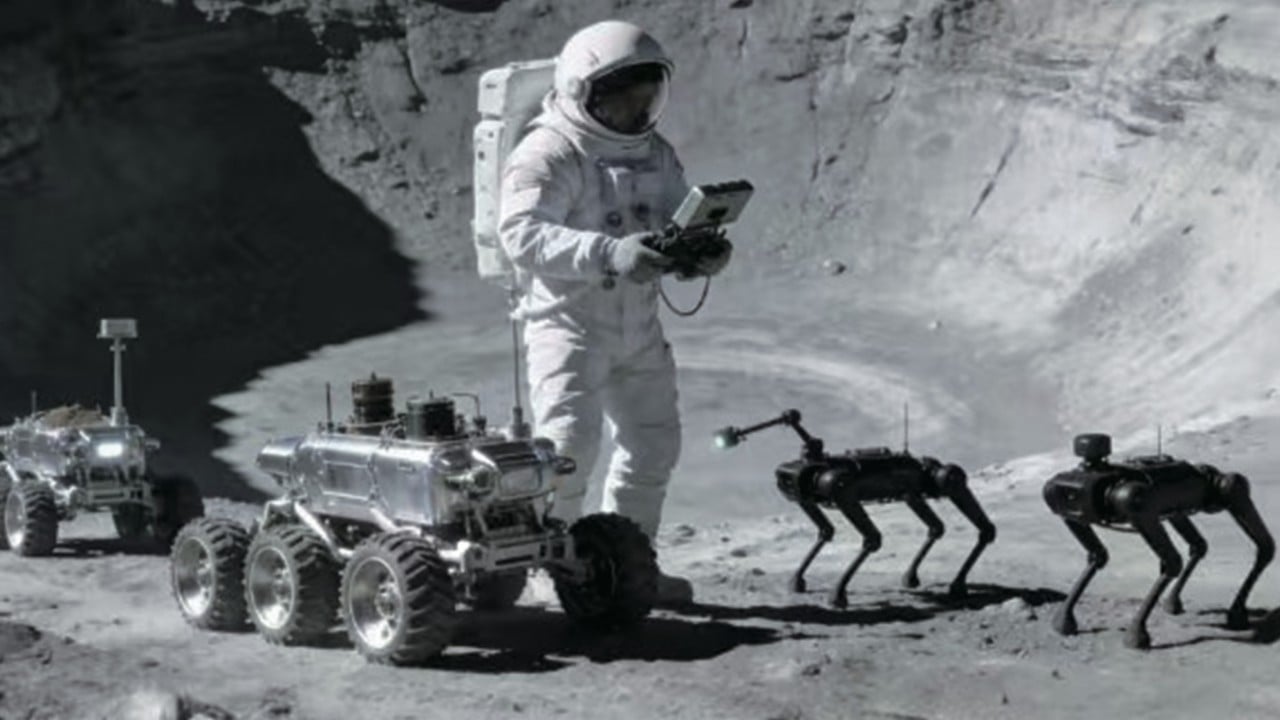
A futuristic proposal envisions robot dogs patrolling China's lunar base, assisting astronauts in their quest for scientific discovery. Researchers from the China Academy of Space Technology envision a crew of three astronauts working alongside these intelligent machines. One astronaut would lead two robot dogs across the lunar surface, while another focuses on collecting rock samples and conducting scientific work.
A third member would remain inside a pressurized rover, overseeing the mission and controlling other robots as needed. This concept, published in the Chinese Space Science and Technology journal, underscores the growing role of robots in lunar exploration and human settlement. The researchers argue that robots will play a pivotal role in extracting lunar resources, preparing habitats, and maintaining living conditions for astronauts.
Beyond their practical applications, robots could even provide companionship to astronauts, helping mitigate the psychological challenges of living in an isolated environment. China is actively advancing its plans for the International Lunar Research Station (ILRS), a multi-phase lunar outpost near the south pole, with the goal of sending astronauts before 2030.
The first phase of the research station is expected by 2035, followed by an expanded complex and lunar-orbiting station by 2045. Despite the promising prospects, significant challenges remain. Unlike Earth, where AI can learn from extensive real-world data, lunar robots must navigate an environment with scarce examples and high stakes.
Moreover, the moon's lack of digital infrastructure necessitates the development of new communication and navigation systems tailored for long-distance space exploration.
Written by urgent.news from Reuters Business via SCMP's reporting — not their text. Machine-written — may contain errors; check the original before relying on it.
This story
This is one outlet's version. Read the fullest account.