Building a Ride-Share Zone-Balancing Agent with LangGraph — Part 5: Coordinating Two Zones at Once
This is Part 5, the last part of this series. Part 4 let a human step into the loop before a risky decision executes. Every part so far, though, has shared one assumption: a zone is evaluated completely on its own. That assumption hides a real inconsistency. driver_bonus and surge_pricing both attract "new drivers," as if from an unlimited outside pool. But a real regional driver pool is finite,…
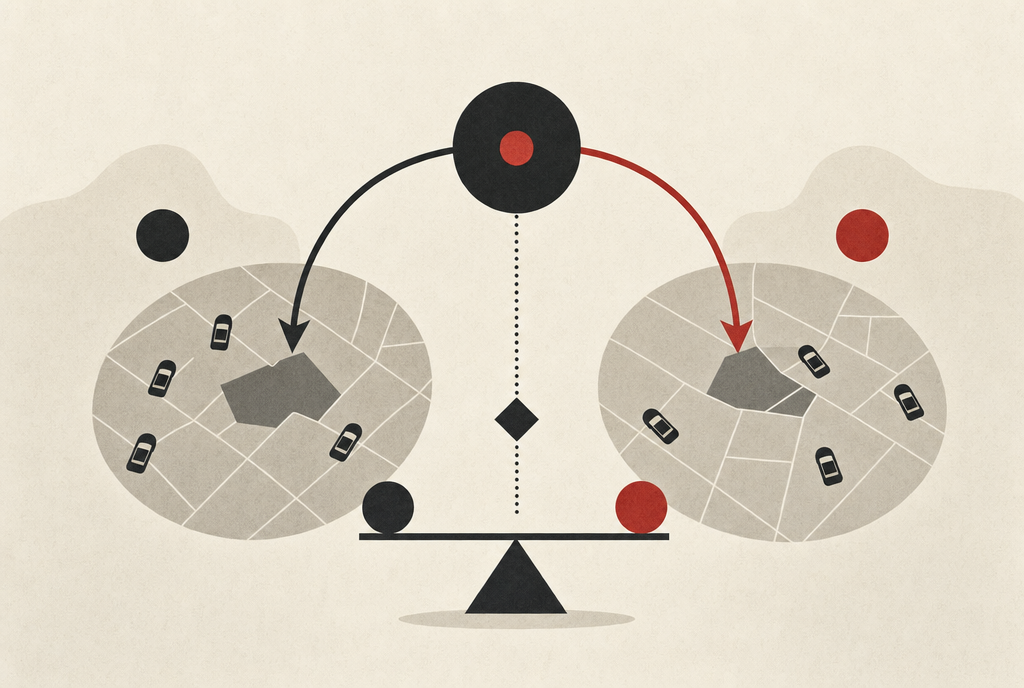
Part 5 introduces a new feature to the ride-share zone-balancing agent, allowing it to coordinate two zones simultaneously. Previously, each zone was evaluated independently, assuming an unlimited supply of drivers. However, this led to inconsistencies when two zones ran aggressive incentives at the same time, as they both claimed to attract new drivers from the same pool.
To address this issue, Part 5 introduces a cross-zone pull request, where a zone can request to draw from the adjacent zone's genuine surplus. This is only a request during evaluation and depends on a resource the requesting zone doesn't control unilaterally. Both zones' evaluations are conducted together every cycle, with a fixed number of 2 zones evaluated at a time.
Each zone gets two new supply channels: a local dormant pool for off-platform drivers and a cross-zone pull request. The agent must now consider whether a zone's cross-zone pull request exceeds what the adjacent zone can comfortably spare. This is evaluated during a new approval stage, with a human deciding whether to approve, reject, or override the request.
The agent's evaluation is done through a fixed number of parallel branches, each represented as a sub-graph. LangGraph's Send API is used to invoke these sub-graphs as atomic nodes, ensuring that both zones are evaluated in the same step. This approach prevents issues where a short branch finishes early and potentially uses outdated information from a slower branch.
The parent graph, reconcile_and_approve, has visibility into both zones at once and handles the new coordination mechanism and interrupt. The per-zone state is identical to Part 2's, with a direct read of each zone's result dict for fields suffixed with _a or _b. This approach is more readable for a fixed number of zones and avoids potential key typos or silent failures.
In summary, Part 5 introduces a new coordination mechanism for two zones, allowing the agent to balance supply and demand more effectively by taking into account cross-zone pulls and thoughtful approval processes.
Written by urgent.news from Dev.to's reporting — not their text. Machine-written — may contain errors; check the original before relying on it.