Why stock market's close is now an auction - explained
For over three decades, the closing price was the volume-weighted average (VWAP) of all trades between 3:00 pm and 3:30 pm. Nobody actually traded at that price. It was a calculation, not a transaction. For long-term investors, nothing changes. For index funds and traders, the closing routine is now different.
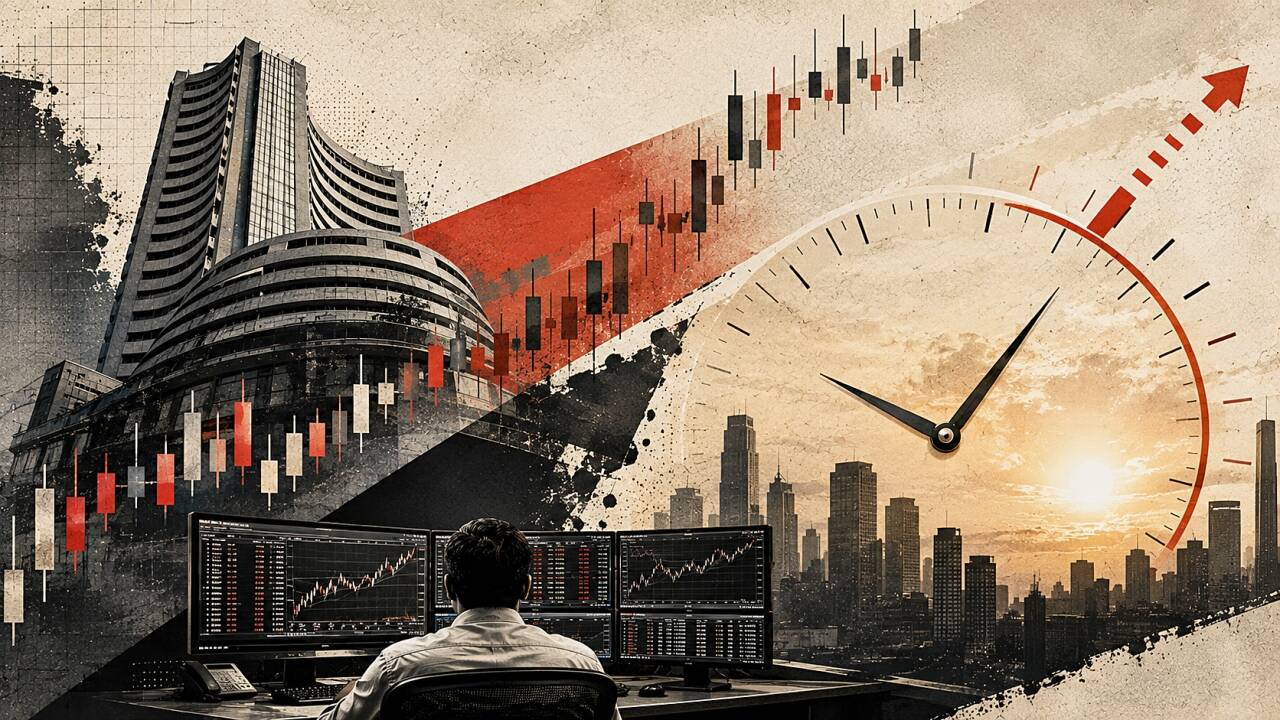
Since 2026, the final price of all shares in the F&O market is determined through an auction instead of the traditional 30-minute weighted average. Long-term investors are unaffected, while traders, index funds, and arbitrage funds must adapt. Previously, the closing price was the volume-weighted average price (VWAP) of all trades between 3 pm and 3:30 pm, but now around 200 stocks with futures and options conclude trading at 3:15 pm and participate in an auction session.
All buy and sell orders are consolidated into one pool, and the exchange determines the price at which the maximum number of shares can be traded, executing all matched orders at that price and designating it as the official closing price. Other stocks continue to close at 3:30 pm, but the NSE refers to this as a phased implementation, with more to follow.
The auction takes place from 3:15 pm to 3:35 pm. During the first five minutes, the exchange establishes a reference price, which is the VWAP of trades between 3:00 and 3:15 pm. Stop-loss orders are cancelled, and iceberg orders, which conceal most of their size, are prohibited. Subsequently, market and limit orders can be placed, altered, or cancelled until 3:25 pm, at which point only limit orders are accepted, and the window closes at a randomly chosen moment between 3:28 and 3:30 pm.
This prevents anyone from timing a last-minute order to influence the close. Following this, matching occurs, and the price concludes at 3:35 pm. Orders cannot deviate more than 3 percent from the reference price. On the first day, the Nifty rose while the Sensex did not, as the auction price impacted the index more significantly than the traditional 30-minute average.
Arbitrageurs and market makers, who typically maintain uniform prices, refrained from participating in the auction to observe its functionality. System performance was satisfactory; it was the pricing that posed challenges. The divergence between spot and futures resulted in the Nifty being approximately 110 points higher than Nifty futures, an occurrence that rarely happens, especially by such a substantial margin.
This gap significantly impacted arbitrage funds, as they buy stocks and sell futures to profit from the difference. Funds' Net Asset Values (NAVs) are calculated automatically based on closing prices; fund houses cannot employ their own assessment of fair value. Consequently, the inflated spot close widened the spread on paper and elevated arbitrage fund NAVs temporarily.
This artificial gain was not actual profit; investors who redeemed on that day were overpaid, and those who invested paid too much for their units. Such gains should correct as prices normalize. A risk persists: Nifty derivatives expire every Tuesday, and final settlement relies on the underlying's close. Although this distortion occurred on a non-expiry day during the initial rollout, a recurrence on an expiry day could transfer real settlement money between traders.
Monitor whether the exchanges refine the mechanism before this scenario is tested. The change is advantageous because the old average had a fundamental flaw. An index fund is designed to mirror the index, and the index is constructed using closing prices. However, no fund could purchase at a price calculated post-facto from 30 minutes of trades.
It dispersed its buying over the half-hour, hoped its average approximated the true value, and the discrepancy became tracking error, which you ultimately paid. The auction rectifies this by making the close a genuine trade, allowing a fund's substantial transactions during an MSCI or FTSE rebalancing day to transact at the exact closing price.
India's financial markets have joined the ranks of New York, London, Frankfurt, and Tokyo, which have all adopted this system for years.
Written by urgent.news from Times of India's reporting — not their text. Machine-written — may contain errors; check the original before relying on it.