Traces of Two Extinct 'Ghost' Ancestors Were Found Hiding in Modern Human DNA, Hinting at Our Extremely Complex Family Tree
Researchers used a new method to investigate past interbreeding with Homo sapiens that doesn't require ancient DNA. The technique identified areas of living humans' genomes that came from unknown hominins, including one from a 1.8 million-year-old lineage
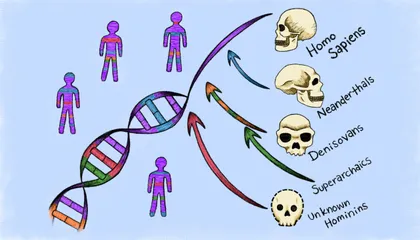
Recent research has uncovered traces of two previously unknown ancient hominin species within the DNA of modern humans, shedding light on a far more complex family tree than previously believed. The study, published in the journal Science, suggests that one of these "ghost" ancestors interbred with Homo sapiens more than 50,000 years ago, while the other contributed genetic material indirectly through Denisovans, another extinct relative, over 200,000 years ago.
Both of these ancient species coexisted with Homo sapiens in Africa, with the ancestors of modern humans diverging from the common lineage approximately 550,000 to 765,000 years ago. From there, the ancestors of Neanderthals and Denisovans diverged from one another and eventually migrated out of Africa, where interbreeding took place.
Today, the genetic makeup of modern humans contains snippets from Neanderthals and Denisovans, with individuals of non-African descent inheriting about 1 to 2 percent of their DNA from Neanderthals and people from Asia and Oceania inheriting roughly 0.1 to 5 percent from Denisovans. Using a novel technique that analyzes current-day human DNA instead of relying on ancient DNA, the researchers were able to trace the origins of these genetic contributions and reveal when they entered the modern human genome.
This groundbreaking study not only confirms the interbreeding of Neanderthals and Denisovans with Homo sapiens but also uncovers evidence of two additional hominin relatives, which each entered the modern human genome at distinct times. One of these ghost ancestors, likely responsible for around 1 percent of modern human genomes, may have been Homo heidelbergensis, a species that lived in Europe, parts of Africa, and potentially Asia around 200,000 to 700,000 years ago.
The other ancient relative, dating back 1.8 million years, was found in the genomes of people in Oceania, indicating that it interbred with Denisovans, who then interbred with Homo sapiens, passing on the hominin's DNA indirectly. The findings highlight that early modern humans did not evolve in isolation but rather as part of a diverse group of ancestors whose existence persists in our genetic makeup.
Written by urgent.news from Smithsonian's reporting — not their text. Machine-written — may contain errors; check the original before relying on it.