TK Accelis: Thyssenkrupp shareholders clear the way for the next spin-off
After TKMS, Thyssenkrupp is also separating its materials trading business from the group. The shareholders approve the spin-off of TK Accelis, but once again warn of excessive power of the parent company.
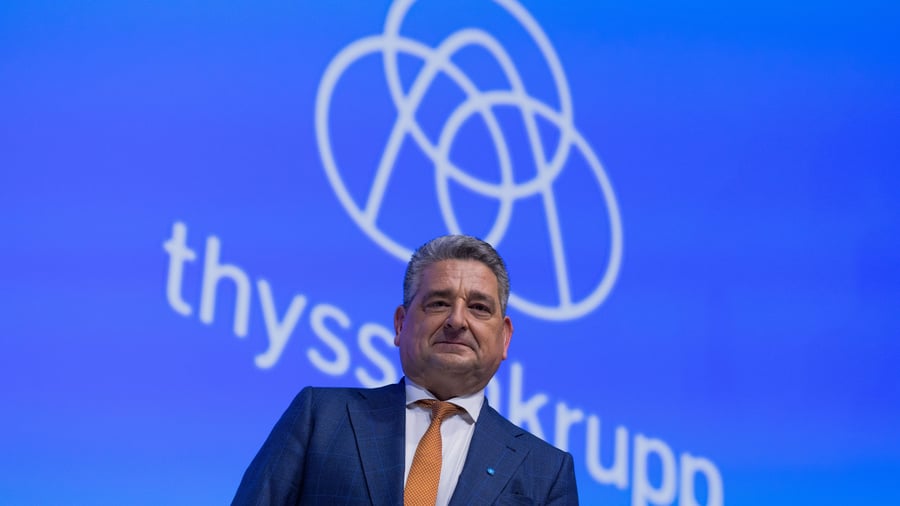
Thyssenkrupp shareholders have paved the way for the next major spin-off of the industrial conglomerate. At an extraordinary general meeting on Friday, they voted to spin off 49 percent of the materials trader TK Accelis, the former Materials Services division, and list the company on the stock exchange. The stock market listing is expected to take place as early as the end of October.
This brings CEO Miguel Lopez one step closer to his goal of transforming Thyssenkrupp from a classic industrial conglomerate into a financial holding with largely independent investments. Just last year, the group spun off 49 percent of its marine division TKMS and listed it on the stock exchange.
However, Thyssenkrupp is not giving up its materials business entirely. The group will retain 51 percent of TK Accelis and thus the majority. This is precisely what has sparked criticism - also from investors. The DWS fund company supported the fundamental independence but asked at the general meeting how independent TK Accelis will actually be.
The economic and factual control remains "firmly in the hands of the parent company," said DWS representative Philipp Weinmann. Minority shareholders, on the other hand, bear the economic risk, while their influence remains limited.
The DWS, like employees and the IG Metall union in the past, is particularly critical of the chosen legal form of an AG & Co. KGaA. It allows Thyssenkrupp more influence than a regular stock corporation. According to the group, the parent company can secure its dominant influence through the construction even if it later reduces its stake from 51 to 30 percent.
In the case of TKMS, Thyssenkrupp had justified the choice of the same legal form, among other things, with the security-political importance of the marine division. This argument does not apply to a materials trader.
The DWS is therefore calling for a perspective to further increase the free float later and possibly convert it into a regular stock corporation. The issue goes beyond TK Accelis. This is because Thyssenkrupp wants to no longer operate all businesses itself in the long term, according to the "ACES 2030" concept. The parent company should focus primarily on its role as a shareholder and the financial management of its portfolio as a financial holding.
The supervisory board will also withdraw from part of the operational control in the future, explained Supervisory Board Chairman Siegfried Russwurm.
For already independent investments such as TKMS and future TK Accelis, his approval requirements will be concentrated on transactions that may have a significant financial impact on Thyssenkrupp AG. However, the holding company will not intervene in the day-to-day business of the listed subsidiaries. The construction therefore leads to a balancing act that is criticized within the group: the subsidiaries should become more entrepreneurial and independent, but Thyssenkrupp should retain a lot of control.
TK Accelis is to become more profitable
For the materials business itself, the spin-off is also an attempt to position a business that has not been too profitable so far in a new way on the capital market. In the 2024/25 financial year, TK Accelis generated sales of €11.4 billion and an adjusted EBIT of €132 million with around 15,500 employees. The company is active at around 400 locations in more than 30 countries and supplies around 250,000 customers.
In the future, CEO Ilse Henne wants to shift the company more from classic materials trading towards processing, logistics, and supply chain management. These businesses promise higher margins and make TK Accelis less dependent on fluctuating material prices. Thyssenkrupp primarily points to growth opportunities in North America and in industries such as data centers, aviation, and defense.
In addition, TK Accelis should be able to raise capital itself and finance acquisitions more easily in the future. Expectations are correspondingly high. In the medium term, TK Accelis aims for annual sales growth of more than four percent and an adjusted EBITDA margin of four to five percent, according to DWS. In 2024/25, this margin was only two percent based on the preliminary combined financial information.
The DWS therefore called for concrete intermediate targets and a deadline by which the higher profitability is to be achieved.
TK Accelis will also be separated from the parent company financially. The company is leaving the Thyssenkrupp cash pool and will receive a credit line of €1.7 billion secured by assets. In addition to the hydrogen subsidiary Nucera and TKMS, the third operational business would then be traded separately on the capital market. The steel division is also expected to become independent in the medium term.
More: "I'm convinced that we're technologically at the top of the world when it comes to conventional submarines."
Translated by urgent.news. Machine-written — may contain errors; check the original before relying on it.