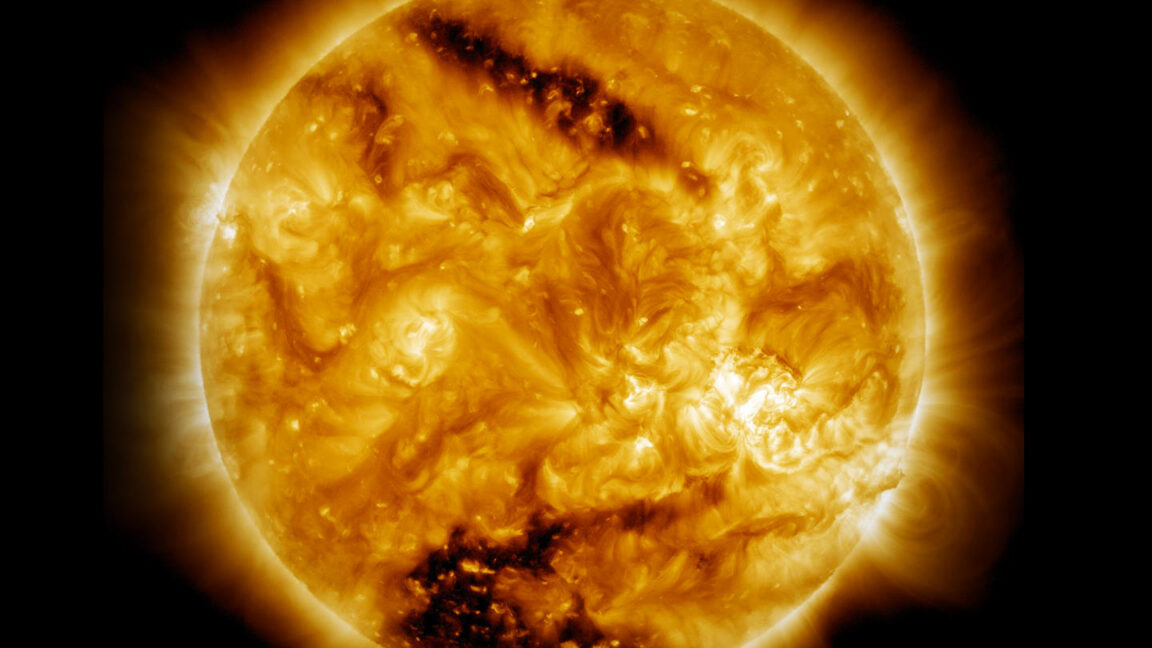
Physicists trace solar outbursts that led to historic Mother's Day storms
On Mother's Day weekend in May 2024, Earth experienced its most powerful geomagnetic storm in two decades, spawning auroras—the ribbony bands of light in the nighttime skies in the Northern and Southern hemispheres—that may have been among the strongest displays on record in the past 500 years.

In May 2024, Earth experienced the most powerful geomagnetic storm in two decades, culminating in auroras that may have been among the strongest on record in the past 500 years. A new study led by the University of Iowa delves into the intricacies of the 10 successive coronal mass ejections (CMEs) that produced the historic storm. The research, titled "Comprehensive MHD modelling of ten successive CMEs driving a historic geomagnetic storm—the 2024 Mother's Day event," was published in The Astrophysical Journal.
The 10 CMEs, occurring over a span of four days, culminated in a colossal magnetic cloud overwhelmed by subsequent eruptions. These eruptions not only expanded the magnetic cloud but also intensified its impact on Earth's magnetosphere. The combined effect was a formidable storm that could be witnessed across a vast geographical range, from Mississippi to the Himalayas and even as far as Queensland, Australia.
Lead author Shirsh Soni, a postdoctoral research fellow at Iowa, highlighted the uniqueness of this event, stating that the simultaneous merging of 10 CMEs was unprecedented. This particular chain of events occurred during solar maximum, a phase of the roughly 11-year solar cycle characterized by heightened magnetic activity on the sun. Scientists speculate that the sun is poised to transition into a declining activity phase, although it will eventually resume its active phase.
The study underscores the importance of incorporating the effects of interacting CMEs into space weather forecasts. Current models typically account for individual eruptions, but this research reveals the critical role of merged clouds in shaping space weather phenomena. By leveraging plasma and magnetic field data from the Wind instrument, the team at Iowa was able to uncover undocumented CMEs, thereby enhancing the accuracy of space weather predictions.
Written by urgent.news from Phys.org's reporting — not their text. Machine-written — may contain errors; check the original before relying on it.