Novo Nordisk: European launch of the weight loss pill is splitting manufacturers and analysts
Germany is the first EU country where the weight loss pill is coming onto the market. Thousands of people are already on waiting lists. But analysts see competition in the long term.
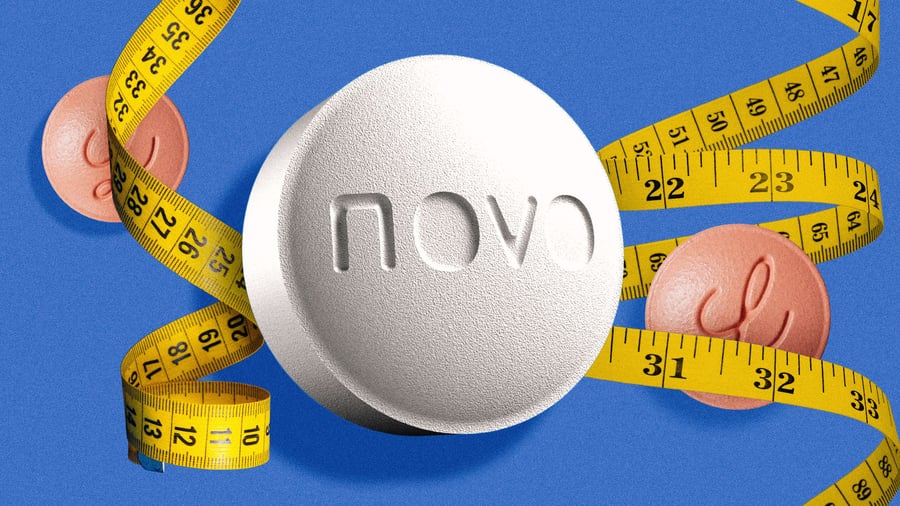
Tablet instead of injection: The Danish pharmaceutical company Novo Nordisk is launching its Wegovy weight loss pill in Germany on September 1. "There are already waiting lists, our trucks are ready," says Emil Larsen, Vice President for International Business at Novo Nordisk, in an interview with the Handelsblatt. For the company, which had Europe's highest market capitalization for several years, a lot is at stake.
This is because Novo Nordisk has lost significant market share to US rival Eli Lilly in the lucrative business of weight loss medications. The weight loss pill is supposed to bring about a turnaround. However, despite a record start in the US, for example, it has not yet convinced analysts and investors. In Germany, however, industry experts expect a rush.
At the Berlin-based healthcare provider Voy, 15,000 people have already registered for the pill, according to the company. Telemedicine providers and doctors record height and weight to check medical suitability for treatment with the weight loss pill in advance. So far, modern GLP-1 weight loss medications have been administered as injections.
In other major markets, the Wegovy pill has been available for some time and is considered the most successful drug launch in history in terms of the number of prescriptions. More than five million prescriptions have been issued to date. The basis for the market launch in Germany is the approval of the medication by the EU in July 2026.
Eli Lilly's weight loss pill has not yet been approved. It is not expected to come to Europe until early next year at the earliest. Market penetration is still low. The daily pill contains semaglutide, the same active ingredient as the company's weight loss injection. Weight loss through treatment is 17 percent and is comparable to that of the injection.
The price is expected to be similar to that of the weight loss injection, which costs between 173 and 278 euros per month, depending on the dosage. Experts consider the market potential in Germany to be high. 17 million people in Germany live with obesity, which corresponds to around 25 percent of the adult population. In Denmark, up to 10 percent of people of working age take weight loss medications, compared to only 2 percent in Germany, according to data from market research company IQVIA from April 2026.
Analysts at JP Morgan's research division expect the global market for weight loss medications to reach a volume of $200 billion by 2030. A significant proportion of this is expected to come from weight loss pills. Other analysts are more cautious, however. British investment bank Jefferies estimates that the market will peak at $80 billion.
Although the Danish company was the first to market a tablet, Eli Lilly could gain a larger market share in the long term. Analysts currently assume that Eli Lilly will reach around 70 percent of the market in the long term, while Novo Nordisk will reach around 30 percent. Reasons for this include stronger marketing, a better strategy, and more production capacity.
Even with the weight loss injection, Eli Lilly was able to overtake the Danes despite a later start. To continue growing, Novo Nordisk wants to persuade people who have been using the weight loss injection to switch to the pill. "With the pill, people see themselves as less of a patient," says Larsen. The treatment is not associated with the hurdle of an injection.
An advantage over Eli Lilly's product is that there are no problems with interactions with other medications. Women who take contraceptives can also use the weight loss pill, Larsen said. For the planned expansion, Novo Nordisk sees itself as well-equipped in terms of production. The company did not disclose which countries will be next.
However, the pill is expected to be launched in some further selected countries by the end of the year. Start in other European markets planned. In Germany, Novo Nordisk is the market leader in the highly competitive business with GLP-1 medications, ahead of Eli Lilly. The Danes want to use this lead to win new patient groups. To this end, the company is in talks with the German government, Larsen said.
The hope is that weight loss medications will be covered by health insurance in the long term. In Switzerland and the US, weight loss medications are already covered. France has recently approved cost coverage for certain patient groups. Novo Nordisk is also in talks with employers and insurers to have them cover the costs of the medications for their employees.
In the US, Novo Nordisk already offers such models. In the UK, the Wegovy pill was approved in June. Within three weeks, 300,000 people took the medication, mainly men, according to Larsen. At Voy, this pattern is also evident in the numbers on the waiting lists, said Sarah Bechstein, a doctor at Voy, to the Handelsblatt. In the United Arab Emirates, Novo Nordisk was the second-largest provider with the pill, according to its own information.
Within a short time, the medication reached more than 50 percent of the weight loss market there. "We had enormous expectations for the launch of the pill outside the US. Reality has exceeded our wildest dreams," says Larsen. Indirect marketing through doctors. If the plan for health insurance coverage does not work out, Novo Nordisk will operate in the self-pay market.
In Germany, this business model is more difficult than in the US because many medications are part of the public healthcare system here. Larsen therefore sees an important role for doctors and telemedicine providers in providing information about weight loss medications. "As a pharmaceutical company, we can only do so much with marketing. The rest is up to the doctors."
Translated by urgent.news. Machine-written — may contain errors; check the original before relying on it.