Moment earthquake shakes hospital operating room in Japan
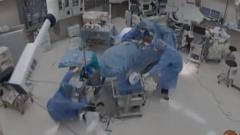
Security camera footage shows doctors shielding a patient on the operating table as last month's magnitude 6.8 quake shook Kumamoto General Hospital.
A false belief propagated online claims that the magnitude 7.1 earthquake that struck southwestern Japan on July 28 was not a natural disaster, but an "artificial earthquake" created by humans. Despite the claims gaining traction with millions of views on social media, experts argue that the theory is illogical due to technological, financial, and practical constraints.
The Seismological Society of Japan has long dismissed the notion, describing it as "unrealistic" in a FAQ section addressing the issue. Drilling a hole deep enough to generate the necessary energy for the tremor would take an extensive amount of time and cost, with the deepest hole ever dug, the Kola Superdeep Borehole, only reaching 12.3km.
While major earthquakes have been triggered by nuclear tests, the technology to execute a nuclear explosion at the bottom of a deep underground hole remains undiscovered. Social media platforms' revenue-enhancing incentive systems are also believed to contribute to the spread of misleading information. Reo Kimura, a professor of disaster psychology, suggests that during times of anxiety, people tend to seek straightforward explanations, making the idea of a deliberate earthquake more appealing than a complex natural explanation.
Written by urgent.news from South China Morning Post's reporting — not their text. Machine-written — may contain errors; check the original before relying on it.
This story
This is one outlet's version. Read the fullest account.