Kultur: Wenn Geschichte zum Luxusgut wird
Die Salzburger Festspiele erleben einen Zuspruch wie selten zuvor. Experten führen das auch auf den KI-Boom zurück – obwohl die Inszenierungen ohne KI entstehen. Wie passt das zusammen?
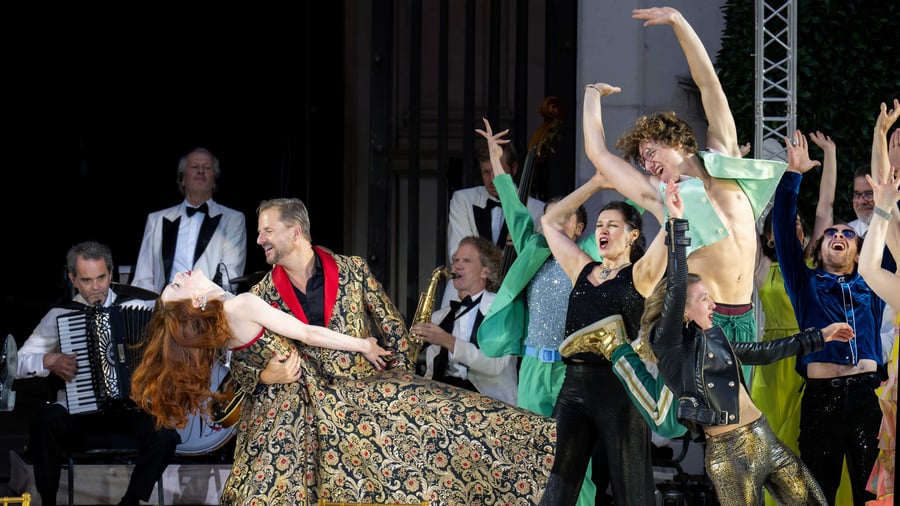
The Jedermann, a wealthy, self-centered playboy, is threatened with death amidst his success. He loses everything – wealth, love, friendship – and is ultimately humbled and rescued. Since 1920, this play by Hugo von Hofmannsthal has been performed every summer before the Salzburg Cathedral. It is the heart of the Salzburg Festspiele.
And the Festspiele, in turn, attract similarly wealthy people. In the past four years, the Festspiele have experienced record summer seasons, with more visitors than ever before. It seems that people are seeking refuge in a place of greater tradition than ever in this increasingly fast-paced, technology-driven world. What is the fascination?
In just 45 days, there are 209 performances at 19 venues. As warm summer evenings fall, Salzburg seems to belong to the Festspiele. But the real luxury does not begin with the first curtain call. It lies in something that cannot be bought or arbitrarily reproduced: the history of a place, the atmosphere of an ancient city, and a cultural heritage that attracts visitors from all over the world.
As artificial intelligence becomes increasingly capable of generating texts, images, and music, the value of authenticity and the one-of-a-kind grows. The Festspiele productions, stresses Festspiel president Kristina Hammer, are almost KI-free. In a single play, Ariadne auf Naxos, the Festspiele experiment with how AI can be used as a creative tool.
Visitors do not just want comfort, but character. They decide not on algorithms, but on experience, intuition, and personal responsibility, says Hammer. She points to the uniqueness of each performance: only in the interaction between artists and audience can that special moment arise, which cannot be digitally generated or arbitrarily reproduced.
For Klaus Heine, a professor of luxury marketing at Emlyon Business School in Rotterdam, this is no coincidence. He says, "Of course, AI offers incredible potential, but at the same time, there will be an incredible demand for identity." The simpler content can be artificially generated, the more valuable become places and experiences bound to a specific location and a specific time.
Luxury today, therefore, is defined differently than a few years ago. "Luxury is always what goes beyond the necessary and ordinary," says Heine. "When uncertainty increases, safety, reliability, and orientation become luxury. Cultural heritage and history gain meaning as they convey origins, continuity, and a sense of belonging."
Written by urgent.news from Handelsblatt's reporting — not their text. Machine-written — may contain errors; check the original before relying on it.
This story
This is one outlet's version. Read the fullest account.
- Kultur: Wenn Geschichte zum Luxusgut wird handelsblatt.com