Culture: When history becomes a luxury item
The Salzburg Festival is experiencing an attendance boom like never before. Experts attribute this to the AI boom - although the productions are created without AI. How do these two things go together?
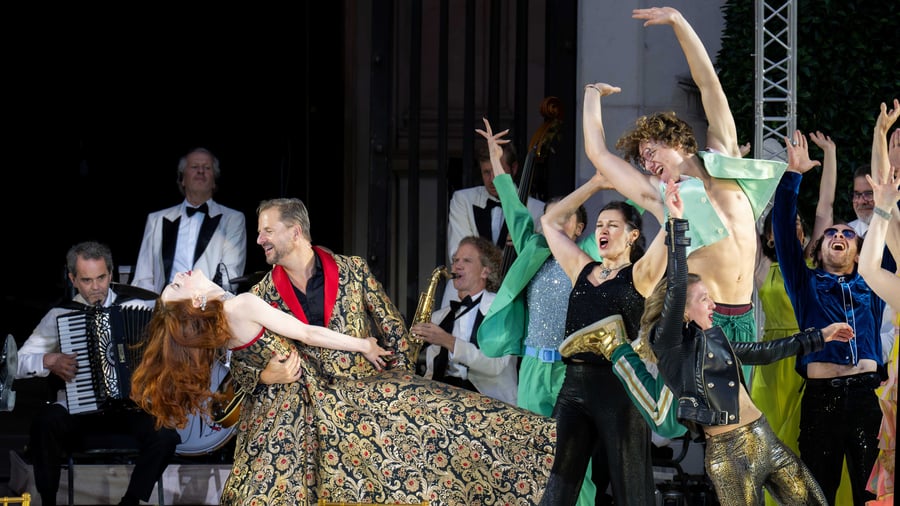
Every man, a rich, egoistic bon vivant, is threatened by death in the midst of success. He loses everything: wealth, love, friendship. And in the end, he is purified and saved. Since 1920, this play by Hugo von Hofmannsthal has been performed every year in the summer in front of Salzburg Cathedral. It is the heart of the Salzburg Festival. And the festival, in turn, is a magnet for people as wealthy as Jedermann.
In the past four years, the festival has experienced record summers. More people than ever before have attended the performances. It seems as though people are seeking refuge in a place that could hardly be more traditional, precisely in this time of rapid change driven by technology. What lies behind the fascination? Within 45 days, there are 209 performances at 19 venues. On warm summer evenings, Salzburg seems to belong to the festival.
However, the real luxury does not begin with the first curtain. It lies in something that cannot be bought or reproduced at will: the history of a place, the atmosphere of a centuries-old city, and a cultural heritage that attracts visitors from all over the world. The more artificial intelligence can generate texts, images, and music, the more valuable authenticity and uniqueness become.
The productions of the festival, emphasizes festival president Kristina Hammer, are almost entirely free of AI. In a single piece, Ariadne auf Naxos, the festival is experimenting with how AI can be used as a creative tool. Visitors do not want just comfort, but character. The program, direction, conducting, or interpretation are not decided by algorithms, but by experience, intuition, and personal responsibility, says Hammer.
She points to the unrepeatable character of each performance: it is only in the interplay between artists and audience that that special moment is created, which cannot be generated digitally or reproduced at will. For Klaus Heine, this is no coincidence. He is a professor of luxury marketing at the Emlyon Business School in Rotterdam.
"AI offers incredible potential, but at the same time, an incredible demand for identity will arise," he says. The easier content can be artificially generated, the more valuable places and experiences become that are tied to a specific location and a specific point in time. Luxury is therefore defined differently today than it was a few years ago.
"Luxury is always what goes beyond what is necessary and ordinary," says expert Heine. "When uncertainty increases, security, reliability, and orientation become luxury. Cultural heritage and history gain importance because they convey origin, continuity, and stability." This development is also evident at the festival. Visitors are increasingly looking not only for comfort or exclusivity but also for places with character and cultural depth.
Events like the Salzburg Festival combine history, encounter, and a unique experience. "Unique live experiences stand for a shift from material to immaterial luxury," says Heine. "What is valuable is not just what one owns, but what one can experience at a specific place at a specific time." So it is not just the festival that draws people to Salzburg.
Almost 60 percent of visitors, according to a survey by the Salzburg Chamber of Commerce, cite the historic old town as a reason for their trip, in addition to the performances.
That it belongs to the UNESCO World Heritage Site makes it a significant part of the Salzburg product. That the festival has long since become an international top meeting point is already evident at the airport. "When you see how many private jets are parked, it's really enormous," says Leo Bauernberger, managing director of Salzburger Land Tourismus.
In July and August, around 600 private jets land here every month, in addition to the large airlines and charter flights. Outside of the festival season, it is usually 350 to 400. Many entrepreneurs and wealthy guests do not travel to Salzburg just for opera and concerts. They appreciate a city that leaves its prominent visitors largely in peace and the atmosphere of various old-established hotels that make the city an international luxury location.
It is the luxury of history, because here, spacious lobbies, spectacular architecture, or extensive suites do not dominate. It is winding corridors, centuries-old wooden beams, rooms with antiques, and historical details that have grown over centuries that make up the character of the Hotel Goldener Hirsch, for example. The house in Getreidegasse was first mentioned as an inn in 1407.
"Today, people are looking for places with history and personality," it says in the hotel. Matthias Winkler, managing director of the Sacher Hotel, explains how important the festival is for the house: "We generate about a quarter of our annual turnover in 45 days." When the opera ends, artists, patrons, and guests meet again at the Sacher - in dinner jackets and evening gowns, with a glass of champagne and conversations until late at night.
Without the numerous events and the festival, there would probably be "no or not so many five-star houses in Salzburg," says Winkler. The festival as an economic factor: but that's how the money flows into the city during these weeks. "The Salzburg Festival is far more than a cultural institution - it is a significant economic factor for Salzburg and for all of Austria," says festival president Hammer.
According to the Chamber of Commerce, 199 million euros are generated in the Salzburg region alone. The festival also has an impact on the whole of Austria, with a value-added effect of 330 million euros. The festival president is convinced that the festival has a special effect on the location: "It stands for a special connection between culture, tourism, and the economy."
Translated by urgent.news. Machine-written — may contain errors; check the original before relying on it.
Also reported by 1 other outlet
- Kultur: Wenn Geschichte zum Luxusgut wird handelsblatt.com