Inside the mystery of the James Webb Space Telescope's little red dots — and how they might be evolving
The James Webb Space Telescope's strange "little red dots" may be evolving into spiral galaxies.
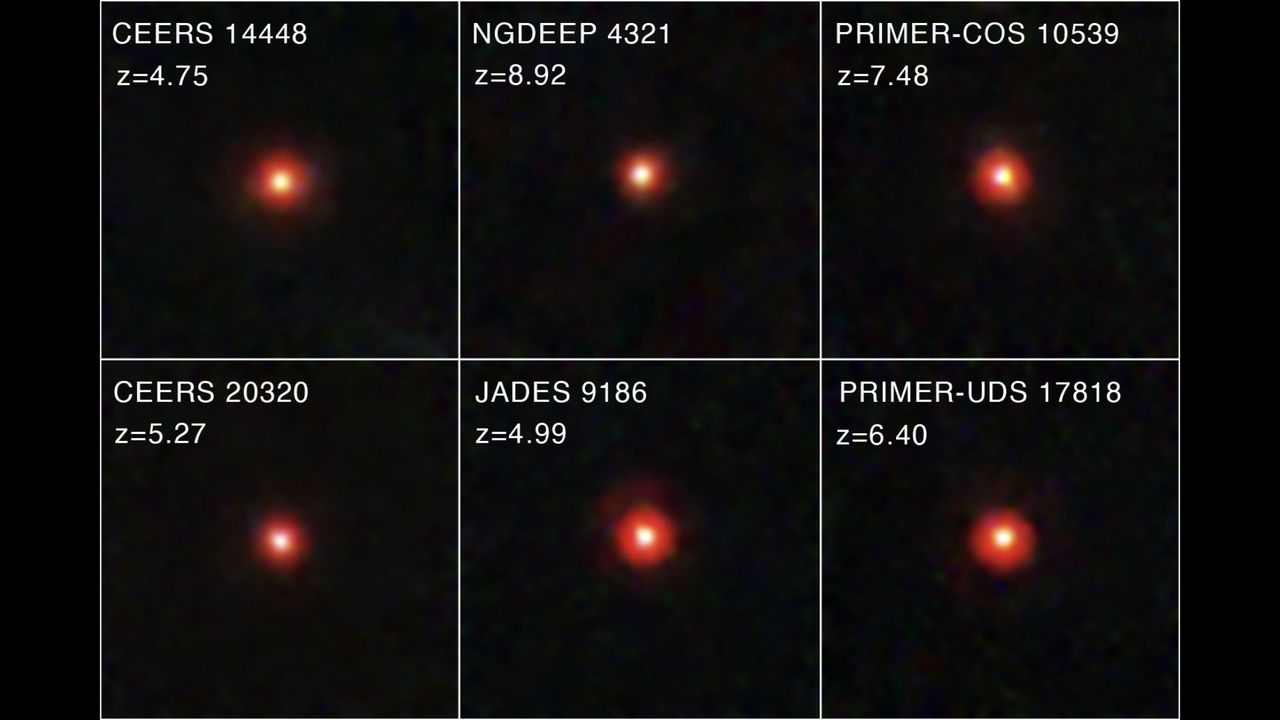
In a recent discovery, researchers have found a possible descendant of the enigmatic 'little red dots' first observed by the James Webb Space Telescope (JWST) in the early universe. The object, dubbed Saguaro, is a galaxy located at a redshift of 2, meaning it was observed as it was 10.5 billion years ago. Saguaro exhibits a spiral structure and a red core, resembling a little red dot in infrared brightness, yet also emitting ultraviolet light and faint X-rays, detected by the Hubble Space Telescope and NASA's Chandra X-ray Observatory respectively.
The presence of X-rays in Saguaro suggests the object has an active galactic nucleus, although the emission is obscured and relatively weak compared to other little red dots. This phenomenon is believed to occur in the case of 'black hole stars,' which are vast clouds of gas heated by a concealed supermassive black hole. As the black hole consumes the star from within, X-rays can escape through holes it creates, explaining the weak X-ray emission observed in Saguaro.
Additionally, an earlier observation of scattered X-rays from another little red dot, 3DHST-AEGIS-12014, supports the hypothesis of black hole stars. Saguaro, existing 1.3 billion years after 3DHST-AEGIS-12014, displays more developed galactic structure, giving insights into the evolution of these mysterious objects.
The researchers simulated Saguaro's appearance at a later stage, and found that if it were still at the same redshift, it would primarily exhibit only its nucleus, resembling the typical little red dot. This implies that little red dots are not an entirely separate class of objects, but rather a developmental phase in the growth of galaxies with supermassive black holes.
The findings offer new insights into the life cycle of little red dots and their connection to modern galaxies, such as the Milky Way, which may have also been a little red dot in the past. Although more research is needed to understand their formation and early stages, Saguaro serves as a crucial link in the story of little red dots and their transformation into modern celestial bodies. The findings were published on July 29 in The Astrophysical Journal.
Written by urgent.news from Space.com's reporting — not their text. Machine-written — may contain errors; check the original before relying on it.