Getting to Know Uranus’s “Breathing” Bow Shock
The ice giant’s rotation causes daily expansion and contraction of the boundary where its magnetic field slows the solar wind.
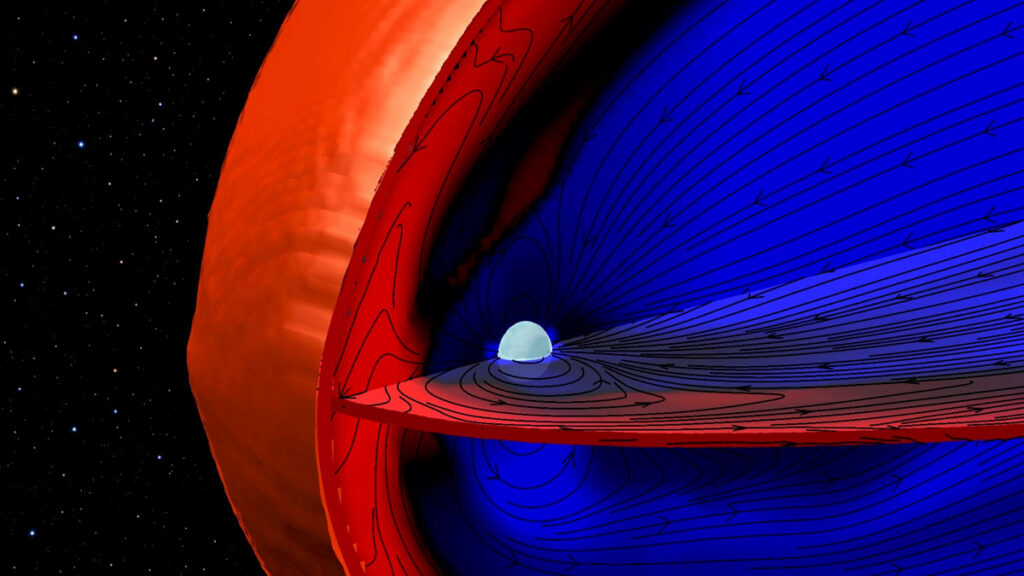
Uranus, a unique celestial body in our solar system, displays an unusual tilt of its spin axis, rolling on its side as it orbits the Sun. Its magnetic field is also oddly offset and tilted, leading to a peculiar interaction with the solar wind. Unlike Earth and other planets, Uranus's bow shock – the turbulent boundary where the solar wind meets the magnetic field – is not stable but rather fluctuates in size and shape throughout each day.
Known as the "breathing" bow shock, this phenomenon has left scientists puzzled regarding its exact extent and drivers. Utilizing advanced computer simulations and data from NASA’s Voyager 2 spacecraft, a recent study led by Cao et al. has unraveled the specifics of these daily changes. By employing a three-dimensional multifluid magnetohydrodynamic model and incorporating Voyager 2's observations from Uranus's equinox, the researchers were able to simulate the bow shock's evolution over a full day.
The simulations demonstrated that the daily pattern was primarily driven by the planet's rotation, as the regular changes persisted even when the solar wind conditions were held constant. This finding contrasts with Earth, where solar wind changes play a more significant role in bow shock variability. These insights could prove invaluable for future Uranus missions and understanding similar bow shocks on ice giant exoplanets across the galaxy.
Written by urgent.news from Eos's reporting — not their text. Machine-written — may contain errors; check the original before relying on it.