Ends with a bang: Why lightning stopped stalking the Strait of Malacca
A bolt from the blue that never strikes the same place twice: Lightning is the proverbial placeholder for the unpredictable. Nature’s light show erupts whenever and wherever positive and negative charges within a storm cloud collide with sufficient force. But if lightning is truly place-agnostic, why does it have a thing for cargo ships? Something odd in the skies above the strait Look at these…
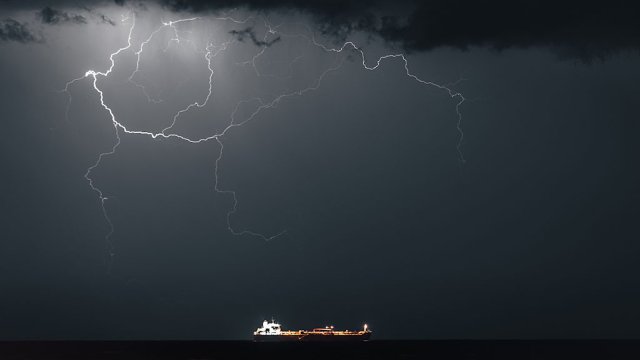
In the Strait of Malacca, a critical maritime route in Southeast Asia, lightning has been known to frequently target cargo ships. This phenomenon can be attributed to the unique conditions above the strait, where particulate matter emitted by ships' engines interacts with clouds, enhancing the electric charge separation within them.
Lightning is more common over land than over the ocean, as land heats up faster and generates strong upward currents that fuel thunderstorms. However, the Strait of Malacca appears to be an anomaly, with an unusually high concentration of lightning strikes along the shipping lane. Researchers have found that over 90% of lightning strikes occur over land, covering just 30% of the planet's surface, while clouds need microscopic particles to condense into airborne droplets to form rain.
Ships burning sulfur-rich bunker fuel release sulfate particles into the air, which enhance cloud formation and the precipitation of ice crystals, leading to a higher likelihood of lightning strikes. With the International Maritime Organization's sulfur cap in marine fuel in 2020, the concentration of polluting particles in the air above shipping lanes has decreased significantly.
As a result, there has been a more than 40% reduction in lightning strikes over shipping lanes and a 67% decrease in anomalous lightning. This unintended consequence of the sulfur cap demonstrates that reducing pollution can have measurable effects on natural phenomena, potentially minimizing risks for vessels while simultaneously mitigating environmental concerns.
Written by urgent.news from Big Think's reporting — not their text. Machine-written — may contain errors; check the original before relying on it.