'Brittle solidarity': What Ceuta tells us about unity in Europe
The events in Ceuta have left Europe grappling with questions about what happened, and what the response says about the strength of relationships within the EU.
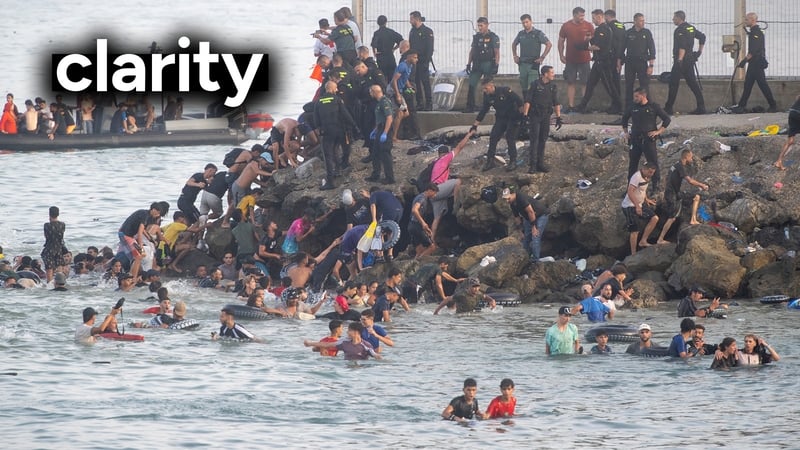
A week after hundreds of thousands of individuals from Morocco entered the Spanish territory of Ceuta, the immediate crisis has largely dissipated. Most of those who crossed have returned to Morocco, and the border is once again under control. However, the incident resulted in over 100 fatalities. EU ministers have since publicly supported Spain.
Nevertheless, the events in Ceuta have prompted Europe to question what transpired and how the response from certain member states reflects the strength of relationships within the European Union.
The cause of the massive movement of people last week remains uncertain. Although claims that Morocco or foreign entities purposefully orchestrated the crisis have not been substantiated, some experts suggest that the recently improved bilateral relations between Spain and Morocco's rival, Algeria, might have played a role. In mid-July, Spanish President Pedro Sánchez visited Algeria, acknowledging it as a "strategic partner" and unveiling investment plans.
This visit occurred just four years after the Algerian ambassador was recalled from Madrid following a dispute in which the Algerian government accused Sánchez of aligning with Morocco in a territorial disagreement. Others speculate that additional factors, such as Morocco's ties with the Trump administration and deteriorating US-Spain relations, may have contributed to the situation.
Senior officials in the Trump administration have openly expressed disdain for Spanish Prime Minister Pedro Sánchez, who has refused to permit US use of Spanish airbases to supply forces bombing Iran and has strongly criticized actions in Gaza. Meanwhile, Morocco's leadership has established connections within the US administration; recently, the US president expressed gratitude after the Moroccan king renamed a major highway in his honor.
However, there is insufficient evidence to suggest that geopolitical or bilateral relations deteriorated and caused the Ceuta incident. What is evident is that false and misleading information spread swiftly online, prompting tens of thousands of individuals to act—possibly influenced by it—and leading to political divisions among EU member states regarding Spain and Europe's response.
For experts on Ceuta and migration policy, this combination is significant. Despite hosting only over 80,000 residents, the small Spanish territory on Morocco's northern coast has frequently found itself at the heart of larger European debates about migration and border security. Professor Elisa Brey of the Complutense University of Madrid, who has studied Ceuta's role in migration between Morocco and Spain, explains that Ceuta's small size makes its events particularly visible because it is an EU land border with Africa and an enclave with a long-standing political dispute with Morocco.
Brey states that for these reasons, every migration episode in Ceuta quickly acquires dimensions far beyond the local. She refers to relations between Spain and Morocco as a "diplomatic thermometer" around Ceuta, noting that when cooperation weakens, pressure is immediately placed on the Spanish authorities and, consequently, on the EU.
It is not the first time a sudden influx of people into Ceuta has become entangled with a broader political dispute. In May 2021, thousands crossed following reports that Moroccan authorities had relaxed border controls amid a diplomatic dispute over Spain's decision to provide medical treatment to Brahim Ghali, leader of the Algeria-backed Polisario Front, which seeks independence for Western Sahara.
Western Sahara is a sparsely populated territory considered by the UN to be occupied by Morocco but partially controlled by the Polisario Front. Brey and her colleague Professor Berta Álvarez-Miranda describe the 2021 episode as an example of "coercive engineered migration"—the deliberate creation, encouragement, or manipulation of population movements to exert political pressure on another country.
Brey states that it is too early to draw the same conclusion about last week's events. While she acknowledges evidence of a border control breakdown and an online dynamic that is likely not entirely spontaneous, she asserts that, unlike in 2021, there is currently insufficient evidence to determine if a foreign government directed the movement or sought a specific concession.
To establish clear responsibility on third countries, she believes it would be unfair at this stage as we lack sufficient evidence.
Written by urgent.news from RTE News's reporting — not their text. Machine-written — may contain errors; check the original before relying on it.
This story
This is one outlet's version. Read the fullest account.