Brit boffins boast of beating barriers to building fusion power
MAST Upgrade installation hit highest pressure ever achieved without the super-hot plasma destabilizing
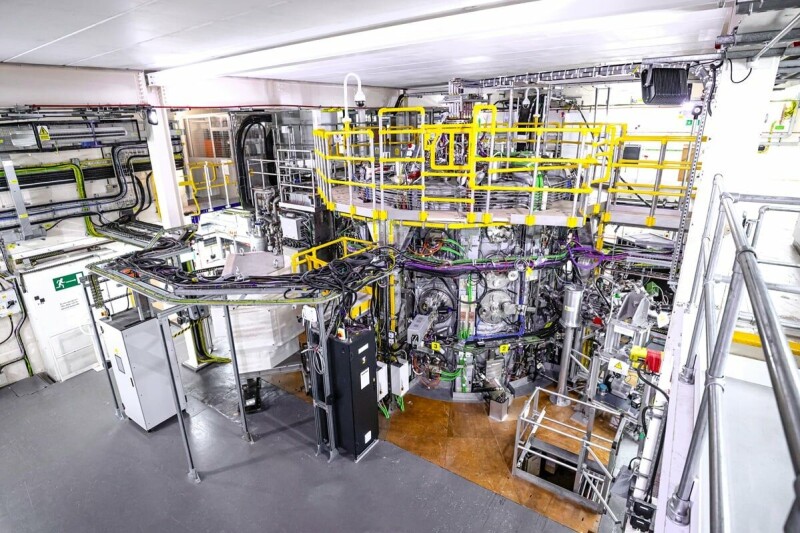
Scientists from the UK Atomic Energy Authority (UKAEA) have made significant strides in the pursuit of commercial fusion power by overcoming plasma instability issues plaguing fusion power plant development. The team, working on the MAST (Mega Amp Spherical Tokamak) Upgrade at the Culham Campus in Oxfordshire, conducted a series of experiments in 2025 and 2026, producing over 1,100 fusion plasmas.
Their research focused on suppressing Edge Localised Modes (ELMs), which cause sudden bursts at the plasma's outer edge and can lead to energy loss and damage to the tokamak's inner wall and exhaust components.
To achieve this goal, the researchers employed two techniques: Quasi-Continuous Exhaust mode (QCE-mode) and Resonant Magnetic Perturbations (RMP). QCE addresses the issue by introducing high-frequency, low-amplitude filaments that bleed off plasma pressure before it reaches dangerous levels. Meanwhile, RMP uses a magnetic field to induce small perturbations at the edge of the plasma, also reducing ELM pressure.
Additionally, the team explored two stable operating regimes, Quiescent H-mode (QH-mode) and I-mode (Intermediate-mode), which improve plasma confinement and mitigate large ELMs.
Furthermore, the scientists developed a technique for controlling the plasma's position by measuring emitted deuterium light from the machine's upper and lower outer divertors, allowing real-time detection of positional imbalances. This innovation could lead to automated, real-time control systems in future commercial power plants.
The research also examined "negative triangularity" plasma shapes, an approach that holds promise for high-power operations without ELMs and is being closely watched by the international fusion community.
The MAST Upgrade installation will receive further enhancements this year, including two new neutral beam injectors that double the machine's heating capacity and the installation of an Electron Bernstein Wave (EBW) system, adding 1.6 MW of heating power. These improvements pave the way for a sixth series of experiments in 2028, which will further advance the research.
Head of MAST Upgrade science at UKAEA, James Harrison, stated that these findings are a significant step towards practical fusion energy and demonstrate the machine's ability to produce science at the leading edge of what is possible.
Written by urgent.news from The Register's reporting — not their text. Machine-written — may contain errors; check the original before relying on it.
Also reported by 1 other outlet
- Brit boffins boast of beating barriers to building fusion power theregister.com