Backscatter Radar Site in Christmas Valley, Oregon
By the 1980s the Cold War had been simmering for over three decades, and seemed likely to continue into the indefinite future. Technology had changed, however. Both sides still feared a surprise attack, but new possibilities had appeared. Instead of fleets of bombers, or ICBMs coming over the pole, an attack by low-level missiles, basically cruise missiles, loomed as a new threat. Such low-flying…
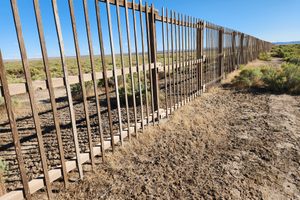
In the 1980s, the Cold War loomed large, with both superpowers fearing surprise attacks. New threats emerged in the form of low-level cruise missiles capable of bypassing traditional radar detection. To counter this, the Christmas Valley Air Force Station, formally known as a backscatter radar site, was built. This facility utilized the Earth's ionosphere as a reflective surface to detect potential threats beyond the horizon.
Comprising three transmitting stations housed in wooden fences, the installation was designed with a ~60º angle between the squares, oriented to face northwest. Completed in the late 1980s, the site remained unused as the Cold War ended. From the 1990s onwards, it was repurposed for drug smuggling tracking and NOAA research on sea surfaces before being fully decommissioned in 1997.
Transferred to Oregon in 2002, the site was proposed for green energy generation, though these plans never materialized. In recent years, it has been used for upper atmosphere research, including studies on the aurora, operated by Dartmouth University. In 2025, the Air Force proposed rebuilding the backscatter radar at the site, indicating the ongoing relevance of such technology in light of evolving geopolitical tensions.
Written by urgent.news from Atlas Obscura's reporting — not their text. Machine-written — may contain errors; check the original before relying on it.